labradore

"We can't allow things that are inaccurate to stand." — The Word of Our Dan, February 19, 2008.

Monday, February 18, 2013

Charity ends at home

In the 1990s, Statistics Canada started keeping figures on charitable giving, and noted that Newfoundland (as it then was) had the highest median charitable donations as reported at income tax time.

Newfoundlanders have never forgotten this fact.

Not even when it long ceased to be true.

Actually, technically it was never true to begin with: StatsCan has calculated the figures retroactively to 1997, and among all jurisdictions, Nunavut came out on top. Newfoundland (as it then was) was tops among the ten provinces.

However, since the late 1990s, the province has slid lower and lower in the rankings, a slide which has picked up pace since 2007. According to the latest StatsCan figures, released last week, Newfoundland and Labrador now ranks sixth among provinces for median charitable donations. Nunavut still leads the country, while Alberta leads among provinces.

The median donation figure in Newfoundland and Labrador has also been stagnant for the five most recent years of data, even declining slightly year over year (along with the other Atlantic provinces) in 2011.

And this, at a time of supposed unprecedented economic growth that is the envy of the entire country.

What’s up with that?


[Data source: CANSIM Table 111-0001]

Labels: ,

Tuesday, February 05, 2013

Private to Richard Todd Byrne

From a Facebook comment on a posting by Ryan Cleary:
Richard Todd Byrne Since Confederation was a fraud.The Terms Of Union with Canada should renegoiated,so that the people of Newfoundland,NL. have total control of it's resources the same as all the landlock province have
Question for Mr. Byrne: which resources does "Newfoundland,NL" not have control over, that the "landlock" provinces do?

Labels:

Wednesday, December 19, 2012

How not to keep a secret

In a letter published in the Telegram on Tuesday, Tom Careen of Placentia writes:
I am sure the huge airport at Goose Bay (built and operational for almost two years in the mid-1940s before the Commission of Government admitted its existence to the people of Newfoundland) was easily able to handle all the VIP air traffic that day.

Um, no.

Some time in the recent past — probably the mid-1990s — someone in Newfoundland invented, out of thin air, the myth that Goose Bay was kept a secret from the people of Newfoundland. The more extreme version of the myth holds that the secret was kept until after Confederation.

It was not.

It is true that the Canadian government, which built the airfield in a jiffy in the fall of 1941, tried, for obvious security reasons (there was a war going on) to keep a lid on the project for as long as possible.

They failed.

Construction at Goose Bay began in early September. As early as September 13 of that year, American President Franklin Roosevelt, in a radio address broadcast around the world alluded to the construction of an allied airfield in Labrador.

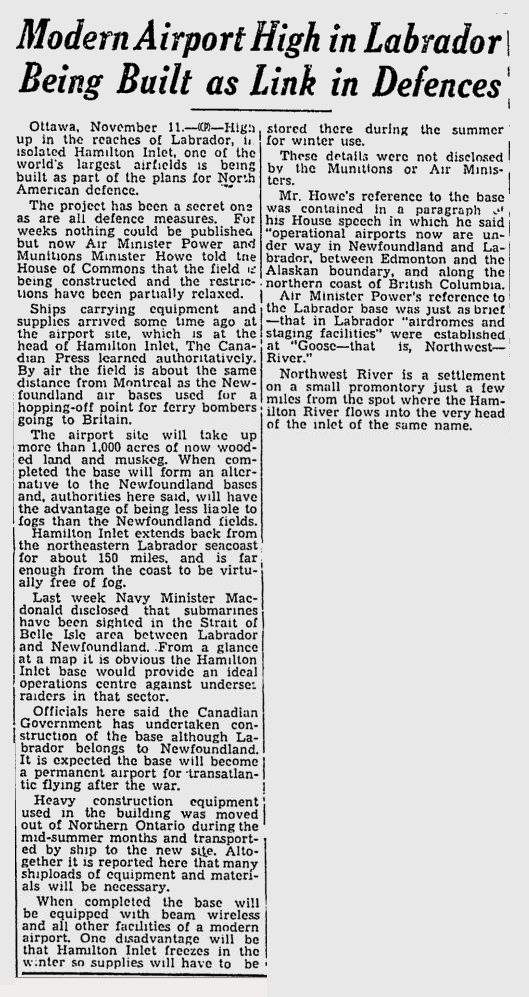
In mid-November, Canadian cabinet minister Charles Power got a little too talkative in the House of Commons, resulting in a fugitive wire story which managed to escape the wartime censors, who didn't like the amount of detail he disclosed. This version was published in the Montreal Gazette, but appeared in daily papers across Canada:

The Canadian, and, starting in 1942, American authorities waged a difficult balancing act between keeping strategically important information about the base secret on the one hand, and striking a tidy propoganda blow against the Axis powers on the other. There were some months of self-imposed censorship, complete with cryptic placelines such as "the Northeast" or "Somewhere in Labrador", which fooled Nazi agents about as much as the phrase "an East Coast Port" disguised Halifax. However, the steady trickle of news, the flood of classfied ads by Macnamara Construction looking for occupations from pipefitters to accountants to go work on some cryptic project in Labrador, and the regular inclusion in daily newspaper rolls of the war dead of men who died in accidents or plane crashes at Goose Bay, easily blew off what little lid of secrecy there ever was.

On the Newfoundland side of things, the Commission of Government not only did not suppress information about the existence of Goose Bay, it actively encouraged Newfoundlanders to seek out employment on the construction project — the first megaproject in Labrador's history — and transported many of them north to Labrador on the government-run coastal steamers in the navigation season of 1942.

Labels: ,

Saturday, November 27, 2010

So many myths

The utterly hopeless John Ibbitson writes in Saturday's edition of the utterly hopeless Globe and Mail:
The myth of Newfoundland, like so many nationalist myths, jars with reality. The province is, for one thing, more urban than rural, with half the population now living in or near St. John’s.
Speaking of myths that jar with reality, HALF THE POPULATION OF THE PROVINCE DOES NOT LIVE IN OR NEAR ST. JOHN'S!

Could whoever keeps telling this lie to Toronto journalists — or to themselves, for that matter — please stop doing so? Just stop it.

Labels: , ,

Sunday, October 17, 2010

Oh noes! Crimes!

A strange and contra-factual statistical claim in a James McLeod piece in Saturday’s Telegram:

Homicide rate on the rise

The province’s chief medical examiner said the number of homicides here is on the rise.

There were 70 homicides in the province between 1997 and 2009.

Stop. Right. There.

The phrase “70 homicides in the province between 1997 and 2009”, comprises thirteen calendar years if counted inclusively, which means an average of about 5.4 homicides per year. (“Homicide”, in the criminal law sense of the term, includes first- and second-degree murder, manslaughter, and infanticide.)

And that is about all the phrase “70 homicides in the province between 1997 and 2009” can tell you. It says absolutely nothing about whether the number or rate of homicides are increasing, decreasing, or stable.

So, what is actually going on?

Well, with a note of caution since the local year-over-year numbers are almost too small to play with in the first place, the answer would seem to lie somewhere between “stable” and “decreasing”. This chart* compares the homicide rate per 100,000 population for Canada, the province, and the St. John’s metropolitan area, since 1961 at the national and provincial level, 1981 for metro St. John’s:


A few things worth noting:

First, despite the widespread popular belief to the contrary, the homicide rate in Canada has been on a relatively steady downward trend since the peak of around 3 per 100,000 was reached in the mid-1970s.

Second, with the exception of a few outlying years, the homicide rate in the province and in the St. John’s metro area is consistently at, or much below, the all-Canada figures.

Third, while there are some years in which the homicide rate in the province or in St. John’s spike upwards, there is no pattern to the spikes. “Spike” years are followed, thankfully, by “crash” years, such as 1999 and 2004 when there were just two homicides reported in the province, 2001 (just one), or 1990 (none).

In case you are having (understandable) trouble spotting any local trends in such blippy figures, here is the same data, averaged out over ten years so as to make long-term trends visible. For example, the figures for 2008 are the trailing averages for the ten calendar years from 1999 to 2008 inclusive:

While there was a long-term increase in the homicide rate in St. John’s through the 1990s, that trend reversed itself a decade ago, to the point where the long-term figure for St. John’s recently dipped below the provincial rate.

And the provincial rate is stable.

There is absolutely no support to be found in the official crime statistics for the assertion that homicide is on the rise in Canada, in Newfoundland and Labrador, or in St. John’s.

It’s a good thing though, that innumeracy isn’t a Criminal Code offence.

[Data source for charts: Statistics Canada CANSIM Tables 253-001 and 253-004.]

Labels: , ,

Friday, July 23, 2010

Exceptions to the rule

The Western Star opens its Friday editorial:

The disputes between this province and Quebec never seem to end. We never hear much from other neighbouring provinces in Confederation
Going out on a limb here, but could that be because…, with the exception of a water boundary with Nova Scotia, there aren’t any other neighbouring provinces? Wacky, but true!

... but Quebec and Newfoundland and Labrador are always at odds over something. It does get tiring.
Indeed it does – though probably not for the reason the editorialist is thinking of. S/he continues:

As usual, instead of sitting down and working out a solution that suits both sides, the two provinces are at odds right from the start and there is little doubt it will be up to a court to settle the standoff….

We always seem to come out on the short end when judges get involved.

Indeed, “we” do.

Well, as long as you forget about what the judges did in the Labrador boundary decision.

Or what the awful judges did in the Canada-France maritime boundary delimitation.

Or what those nefarious judges did in the Laurentian boundary case with Nova Scotia.

But hey, as long as you ignore each case which isn’t consistent with the political mythology, and omit anything which doesn’t conform to your predetermined conclusion, then, sure, editorialist, we always seem to come out on the short end when judges get involved, except in all those other pesky cases when we don’t.

Labels:

Sunday, May 23, 2010

That would explain all the centenarians

Real estate agent Jim Burton buys into another popular myth:

"It's estimated there's some 500,000 Newfoundlanders that live away from Newfoundland and they're always looking back at what's happening at home, and they're being smart and investing back in their province for the day when they return."
Estimated. Passive voice. Estimated by whom?

Between 1936 and 2008, there were a total 720,014 live births in Newfoundland and Labrador. Add another 250,000 as a highball estimate for those born between 1901 and 1935 inclusive (there were 7342 live births in 1936). Then add another 7,000 born since December 31, 2008, again a highball estimate based on the 4365 born in 2008 according to preliminary figures.

That gives you just under 975,000 people born in Newfoundland and Labrador since January 1, 1901.

If there are 500,000 “Newfoundlanders” living away from Newfoundland, that means that there are only 475,000 people who were born in the province still living in it...

That is, assuming that not one person who was born in Newfoundland and Labrador since January 1, 1901, has ever died.

Labels: