labradore

"We can't allow things that are inaccurate to stand." — The Word of Our Dan, February 19, 2008.

Monday, October 17, 2011

Vexatiously Omitting Contextual Matter

Last Thursday, VOCM reported:
NL Leading Country in GDP Growth: BMO
Thursday, October 13, 2011

Despite the fact growth in the province's economy is cooling, Newfoundland and Labrador will still lead the country in GDP growth according to BMO. Economist Robert Kavcic says our economy will grow by 3.5 percent thanks to construction and offshore oil projects. He says the biggest economic driver is construction, with government spending expected to total more than one billion dollars in the current fiscal year. Kavcic predicts growth will decelerate next year as fiscal stimulus winds down.
BMO's full monitor, in fact, goes on to state:
Atlantic Canada should see growth below 2% through 2012. ... Newfoundland & Labrador is an exception, as it is expected to grow a robust 3.5% this year,
thanks to energy-sector investment and a continued commitment to aggressive capital spending by the Province. But, that pace will also cool by 2012 as some projects begin to wind down.

...

Saskatchewan is one of only two provinces (the other is Newfoundland and Labrador) on track to be in the black this fiscal year, and the only one projected to be there persistently in the future.

...

Newfoundland and Labrador’s Public Accounts for FY10/11 and midyear fiscal update for FY11/12 are pending. In this spring’s Budget, the Province projected a $59 mln surplus for FY11/12 (0.2% of GDP), after an estimated $485 mln surplus in FY10/11 (1.6%). Budget balances were projected to switch to deficits in FY12/13 and FY13/14 ($496 mln and $310 mln, respectively), before returning to surplus in FY14/15.

Labels: ,

Tuesday, July 12, 2011

By request for hyeall (II)

It's July, that most wonderful time of the year... when Statistics Canada brings its free public data portal, CANSIM, up to date to June 2011.

This means a body can update now-outdated charts which he produced just scant weeks ago for your colour-enhanced enjoyment.

Once again, here is the stacked-bar portrayal of the provincial employed labour force, distinguishing three classes of working people: public-sector employees (which includes federal, provincial, and local government employees as well as crown corporation employees), private-sector employees, and the self-employed. As with previous charts of this type, the figure for any one month is actually the average of the previous twelve months inclusive. This smooths out seasonal variation which otherwise makes trends hard to spot.

Here is the same information, but as a stacked numerical total (in thousands of persons):
This is the picture with public-sector employees excluded. Only private-sector employees and the self-employed figures (again in thousands) are included.


It is noteworthy, and not a little troubling, that the private-sector labour force has not yet recovered to the pre-recession plateau (shown as a red line). It is also a potential worrying sign that growth in the private-sector employment force, after about a year of respectable gains compared to the 2008 recession, has levelled off.
And here is the numerical growth in the public-sector employment force all by its lonesome. Again, this is the sum of all public-sector employees, including employees of all levels of government and all crown corporations. In the five years since the recent-historic low, in early 2006, of about 55,600 public-sector employees, the public-sector labour force has increased by about 11,500 or over 20%. As a share of total employment, the public sector has grown from 26% to 30%.

The twelve-month average ending in June 2011 was 67,100 — an increase of 4100, or 6.5%, from the same period twelve months earlier. This represented an increase of over half a percentage point in the public sector's overall share of the employed labour force.

Data source: Statistics Canada CANSIM Table 282-0011

Labels: , ,

Thursday, June 09, 2011

Chumbawilliams

Just in case anyone out there is still, like Wade Locke, coming to grips with the fiscal legacy of seven years of unfettered Williams Effect, let it not be said that you weren't already warned, and that you didn't get that warning straight from the top.

As Danny Williams-Government told Fred Hutton of NTV in his 2008 year-end interview, which aired early in January 2009:
As you pay down the debt it also gives you the ability then to bring it back up. It’s no different than if you paid down your line of credit at the bank or pay off your car loan, it gives you the ability to go borrow a little more, take a little more if you need it. So, that money will be used, for example, that, that surplus that’s actually going on the debt, though, will also be used to fund, you know, the settlements with the unions. I think the public sector settlements are going to cost us in the range of a half-billion dollars a year forever. So, that money will sort of go, go towards the public sector workers, which is, which is good, though, from an economic perspective because now we have this whole new infusion of eight percent and then four, four, and four into the economy and that’ll help drive our own economy, as well.
You read that right.

You pay debt down. Then rack it up again. You're never gonna pay it down. You pay debt down. Then rack it up again. You're never gonna pay it down. You pay debt down. Then rack it up again. You're never gonna pay it down. You pay debt down. Then rack it up again. You're never gonna pay it down.

And that "half-billion dollars a year forever"?

Between now and 2031, the Great Economist laid out a scenario last night that would see the provincial debt balloon to $37-billion — with a b. That's about $72,500 for every person currently living in the province... and, contrary to popular perception, the provincial population has started to decline again.

"Half-billion dollars a year forever", over the twenty years to come between now and 2031, accounts for ten of those thirty-seven billions.

And that's just in the first twenty years of "forever".

Labels: ,

Wednesday, June 08, 2011

By request for hyeall

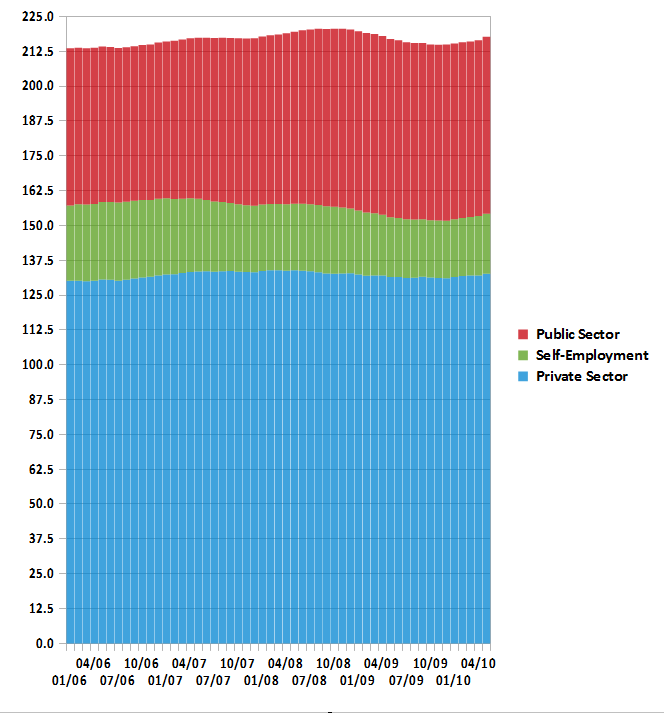
Tweep "hyeall" was interested in seeing the public sector* work-force as a share of overall employment.

Ask, and ye shall receive. Here are the figures, in stacked-bar graphic form, for the five-ish years up to April 2010. (Updated figures should be available in a few weeks):

Nearly 30% of working people in the province work directly for some level of government or other public entity.

Here is the raw job-count (in thousands), with the same colour scheme:

And here is the job picture with public-sector employment excluded. The "boom", resulting in "record employment", is not coming from organic growth in the private-sector economy:

Careful examination will reveal that the private-sector employment and self-employment job figures plateaued in 2006.

By 2007, and the Summer of Happies, when former Premier whassisname was boasting about all the "pigeons" at the arrivals area of Newfoundland International Airport, coming home to work in the booming economy, the private-sector employed and self-employed labour force was already beginning to weaken.

It continued to weaken through the rest of the decade, turning around only in early 2010. The turnaround, at least to the end of available data, had not seen the figures recover to pre-slump levels.


* Includes the entire public sector: provincial, federal, and local government.
Data source: Statistics Canada CANSIM Table 282-0011.

Labels: , ,

Saturday, May 07, 2011

Burying the lede

From the Globe and Mail's fly-in team:

Long plagued by sky-high unemployment, Newfoundland has seen its job market buoyed by its offshore energy resources, but the wealth has filtered through to other industries. Natural resources – which include not only oil but the more traditional industries of fishing and forestry – added about 2,000 workers, Statistics Canada said. Construction, manufacturing and trade grew even more, and public administration also saw a huge jump.

Labels:

Thursday, January 20, 2011

Don Mills (I)

Don Mills is puzzled:
“The good news is that the numbers have been coming down, generally speaking, going in the right direction,” said Mills. “The bad news is that this does not make sense to me. How can you be a have province with a 13 and a half per cent unemployment rate? How is that possible? There’s a disconnect here.”
Why, yes, there is a disconnect, Don.

"Have province" means a province which does not receive equalization, its own-source revenue, per-capita, being above the threshold for receiving equalization.

In any province, this status is only very remotely connected to employment levels. And in a province such as the one where the puzzled Don Mills was speaking, where two industries account for a huge chunk of the provincial own-source revenue, but a very small chunk of the labour force, that connection is even remoter still.

So there you go.

Labels:

Monday, November 15, 2010

Optimist vs. Pessimist

Two local news outlets cover the same press release:


Labels: ,

Thursday, May 20, 2010

How's yer bubble?

On October 5, 2008, Dear Leader, in a radio appearance of a Sunday night, revealed the existence of the magical financial bubble:
And on the other side of it, you know, from our own perspective, you know, our economy is strong, we're in a better position than we've ever been, we're also in a very good position now with the, you know, the international financial crisis that's underway. We now, for the first time in our lives, are in a bit of a financial bubble and that's a wonderful thing. We have that protection and the people of this province got the support of the provincial government.
According to the latest figures, (finally) published this week by the Newfoundland and Labrador Statistics Agency, all but two of the province's 20 economic zones saw a loss in the number of business enteprises between 2007 (the last of the pre-recession years) and 2009 (the most recent data.) They were the Northeast Avalon and Central Labrador, shown here in green.


Most zones had declines of up to five percent (yellow) or between five and ten percent (orange). The two zones in red lost more than ten percent of their business enterprises during the recession, despite the presence of the magic bubble and the operation of the Williams Effect (on a go-forward basis, naturally).

Labels: , ,

Saturday, April 10, 2010

Wishful thinking

Someone in one of the Quebec Daily Newspapers puts on their rose- blue- oil-coloured glasses and editorializes:

Deficits will hang around for a few years in this province until the recovery is complete, but if the oil keeps flowing and prices stay up, paying off the debt should be manageable.
Meanwhile, over in St. John’s, in the province of Newfoundland and Labrador and Reality, Moira Baird reports for the other QDN:

Thirteen years of oil production off Newfoundland and Labrador resembles a small mountain range of peaks and valleys when plotted on a chart.

And as things stretch into the future, the chart looks a bit grim.

The highest oil production peak - which occurred in 2007 to 2008 - is already a memory.
The on-line version of the story has a table, which, in the print edition, ran on the very firstest page of the paper, in the form of this accompanying graphamajig:

[Image captured from the on-line version of The Telegram of today's date.]

Labels:

Friday, June 26, 2009

Optimists Club

In Corner Brook, where the major industry is facing layoffs and compression, the local leaders are already staunch co-religionists of the First Newfoundland Church of Optimism:

Mel Woodman, president of the Greater Corner Brook Board of Trade, is an optimist by nature and refuses to accept the significant workforce reduction at the mill is going to ruin Corner Brook and surrounding region.

[...]

Corner Brook Mayor Charles Pender also said this is bad news, but not a death knell for the city since there is still hope of a return to a three-machine operation. The blow on Corner Brook directly, he figured, will be softened somewhat by the fact there will be some early retirements amongst the 130 people laid off and the fact the 60 forestry workers affected are spread out among many communities from Codroy Valley to Glenwood.
And over in Gander, Claude Elliott has accepted Optimism into his life:
Gander Mayor Claude Elliott says he is devastated with word of the layoffs at Heli-One Composites. However, Elliot says given the current global economic crisis, the layoff notices aren't surprising. Despite the news Elliott says he remains optimistic. Elliott says council will be working closely with the company to try and work through the crisis to see what they can accomplish together. He says the town is hoping the aerospace industry will recover soon.

Labels:

Thursday, June 25, 2009

Nothing but bluebirds

More from the recent-memory hole. From a Terry Roberts report in the Telegram of November 22, 2008, quoting MUN economist Wade:

Locke stressed, however, that it's not all doom and gloom.

In historical terms, commodity prices are still strong, he explained, and there are positive signs everywhere.

He singled out the confidence shown by the Iron Ore Company of Canada in Labrador West, where a major expansion is planned.

"That should tell you everything you need to know. That company believes the future is bright for them and they're increasing their capacity now to take advantage of an improving situation in the future," he said.

Labels: ,

Friday, June 12, 2009

The power of positive thinking

The perennial optimist is feeling economistic:
Economist Calls for Prosperity Plan
June 10, 2009

Memorial University economist, Dr. Wade Locke, says he'd like to see the province put a prosperity plan in place. Locke says the province has fared well during the economic recession and upcoming projects will bring the province to a new level of prosperity.
It would — scratch that, it will — be interesting to see which parts of the province have “fared well” during the economic recession. Economic recessions, after all, are known for being happy times.

As the treasonous BondPapers notes, year over year, the percentage change in the employment figure is staggering.

Adjusted for seasonality, the “employment force” — the overall number of people working, whether full-time or part-time — has contracted by over 5% in the past year. To put that into historical perspective, this graph shows the same data as in the BondPapers posting… only projected back in time for as long as StatsCan has comparable data on the subject, back to 1977:

The year-over-year decline of 5.3% observed in Newfoundland and Labrador from May to May is on par with the declines observed during the bruising North American and international recessions of 1981 and 1991, and with the more localized mid-1990s job losses that may be related to the end of major onshore Hibernia work and the end of the NCARP/TAGS program.

This second graph “zooms in” on more recent trends. It is the same data as in the above graph, only for this decade only. Periods in which the employment picture was better than the same month one year before are shown as green peaks. Periods in which it is worse are red valleys.

This corner, for one, would hate to see what these figures would look like, had the province not fared so well during the current recession.

Labels: , ,

Wednesday, May 27, 2009

Department of Predictable "News" Items

The Ministry of Truth reports:
MUN Professor Upbeat About Economy
May 27, 2009

Memorial University economics professor, Wade Locke, predicts a noticeable improvement in our economy by the end of the year. He told the St. John's Board of Trade yesterday while we are suffering some short-term issues, all indications show our province should be okay. Locke says revenue may be down this year, but things are starting to move in the right direction. Locke says employment could be an issue for a while yet. He points out our seasonal work patterns, such as construction work and the fishery.

There you have it. MUN economist optomistic. In related news: Sun to rise in east, set in west.

Labels:

Tuesday, October 07, 2008

Or, alternatively

Optimist economistic.

Labels: