labradore

"We can't allow things that are inaccurate to stand." — The Word of Our Dan, February 19, 2008.

Wednesday, January 31, 2007

Sentence fragments.

Lots of sentence fragments. Sentence fragments are, "young" and "cool", perhaps?
Rich with history. Rife with culture. Sprawling with natural beauty. All these wonders have been here for thousands of years, embraced by those who happened upon them. It’s up to the traveler to enjoy them, to go vigorously in search of people, adventure, of experience. Around every corner, around every bend, you will find a piece of heaven, a delightful sight, a playful breeze that will help your journey.
And oy! Holy redundancies Batman:
Below is a map of Labrador Skies, the region covering the Labrador portion of Newfoundland and Labrador.
"Labrador Skies"? Other places don't have skies? Isn't the point of tourism marketing to highlight what you have that is unique?

And wow! The "Lighthouses" page manages to ignore Point Amour, the tallest in the province, tied with Point-au-Père as the tallest on Canada's Atlantic seaboard, and second-tallest in the country, and about to celebrate its sesquicentennial.

If Point Amour was anywhere near St. John's, you think the tourism people might have noted any of that?

Monday, January 29, 2007

Staggering

It's reassuring to know that no, Danny Williams, Great Businessman, isn't deliberately throwing the provincial economy down the toilet, he's just rationing.

Shunned?

John Efford got one. So did Dr. Max House and Sister Elizabeth Davis, simultaneously. Team Gushue got theirs, and then some. And Gen. Rick Hillier, of course, got one. He has guns.

So you've gotta wonder... even though it's local boy does good, and it boosts the much-coveted "federal presence" to boot... why didn't Loyola Sullivan's appointment as Ambassador to the Fishes merit one of Chairman Dan's laudatory press releases?

Williams' Alberta Trip Successful: Williams

This:
Premier Pleased with Opportunity to Promote
Newfoundland and Labrador in Alberta

The Honourable Danny Williams, Premier of Newfoundland and Labrador, was accompanied by 13 Newfoundland and Labrador business people representing nine companies, to Edmonton and Fort McMurray, Alberta January 25 – 27. The delegation was part of a mission organized by the Council of Atlantic Premiers to link companies from the Atlantic region to business opportunities in that province. While in Alberta, both Premier Williams and senior representatives of the companies took part in receptions in both cities, a breakfast meeting with a local development association and its members, and a tour of the Syncrude oil sands site. The business representatives also spent a couple of days making contacts on an individual basis. Everyone involved in the mission believe it was a success and look forward to building upon the relationships established.
and this:
Williams Pleased With Trip Out West
January 29, 2007

Premier Danny Williams travels would appear to be paying off -big time. At least that's his consensus after his trek to Saskatchewan and Alberta. Williams says he's gained more support in his stand against inclusion of non-renewable resources in the equalization formula. Premier Williams told VOCM Open Line with Randy Simms, we have to face the reality that Alberta is the nation's major oil player. Williams says the business groups that accompanied him on the trek are looking forward to big things. The Premier says Fort McMurray will become one of Canada's leading communities over the next couple of decades.
are exactly the sorts of behavior that Dr. Kellogg was obsessed with eradicating.

Is the party over?

Maybe it's an antiquated notion, but isn't the purpose of a supposed political party to, like, you know, run in elections?

Things that bug people

From the Sunday running of the St. John's Telegram, and Tara Mullowney's pre-appearance profile of historian Margaret MacMillan:
Examples of history influencing residents and policy-makers in Newfoundland and Labrador abound, she said, with this province's history as a British colony often shaping local people's attitudes towards the rest of Canada.

"It seems to me when I meet people from Newfoundland, you have a very different sense of yourself culturally," MacMillan said. "It's partly geography, too - you're an island and that affects people. Also, I notice when you're talking about the Churchill Falls deal, it obviously still bugs people."
Hey, you know what else bugs people?

Those people who "have a sense of themselves... as an island" who insist on still being "bugged" by the decidedly non-insular Churchill Falls deal.

That bugs people.

Sunday, January 28, 2007

An early Groundhog Day

You ever have one of those days where you wake up, and it's like you're re-living the same day over and over and over and over and over and over and over again?

Today is one of those days. From the Ministry of Truth:
Just Wait Ten Years From Now
January 28, 2007

The premier of Newfoundland and Labrador is promising compatriots who've moved to Alberta that in about 10 years, they'll have an economy worth coming home to.

Danny Williams spoke yesterday at a 15-dollar-a-head meet and greet for Newfoundland's expatriates in Fort McMurray. Appealing directly to about 150 of his compatriots working in the city, Williams said he knows some will remain in Fort McMurray for the rest of their lives because their family is there. But for others who want to go home, he said his job is to boost Newfoundland's economy so they can get the kind of jobs they have in Alberta.
Brian Peckford couldn't have said it any better himself: "One day, the sun will shine, and 'have-not' will be no more."

"One day."

"Ten years from now."

It might have been Crosbie who complained about the tendency of Newfoundland politicians to fall into "El Dorado" syndrome: hold out the hope of some future megaproject, however mythical, that would embarrass a sheikh; that the current megaproject, or artist's sketch, would be "the one to save us."

They also used to say "Cape St. Mary's Pays For All."

"Ten years from now" is conveniently beyond Danny's personal event-horizon. By choice or by other circumstances — remember, on her way out the door, Margaret Thatcher famously, and bittersweetly, quipped, "It's a funny old world." — this will be long after Danny Williams isn't there to kick around anymore.

Playing out the "have not will be no more" is a cynical and cynicizing game even at the best of times.

These are not the best of times.

In about six weeks, the 2006 census figures will come down. The numbers are going to go off like a bomb on the local political scene. And the province does not have the luxury of Danny's self-established timeline of ten years to start mitigating the trends that those statistics will lay bare.

Proportion

"Williams" is to "homing pigeons" as "Parizeau" is to "lobsters".

Discuss.

Friday, January 26, 2007

Questioning Danny's version

Fast-forwarding to today’s Telegram and its editorial, “Danny’s version”.

Williams pointedly told the audience that the per capita debt of individual Newfoundlanders increased tenfold when we joined Canada. It’s an interesting
number, but like most subjective and selective numbers, unlikely one that tells
the whole story.

The fact is that you can take a whole host of numbers out of context to defend any argument. And further, if you’re allowed to include some numbers — like the total landed value of the fishery and the total value of the oil and gas in the offshore (while discounting the fact that those resources gain their value through commercial exploitation and the necessary profit-taking involved) — and choose to simply disregard others, you can make an economic case that holds attention without ever really holding water.
Sadly, that’s almost the National Sport of the Secret Nation these days. Just witness the sorry statistical spectacle that was The Independent’s “balance sheet” exercise the other year.

The editorialist ungently pokes a Great Big Hole in the Premier’s logic and rhetoric:
The problem is, the argument — perhaps unintentionally on Williams’ part — also
makes another point.

It is the natural precursor to the “It’s my football, and if I can’t set the rules, I’m taking it and going home” school of negotiation.

And that’s a school of argument that you could easily suggest has done a tremendous amount of damage to this country as a whole.

[…]

The “we were better off without you” argument may be popular with the home crowd, but it’s not likely to garner much more than polite applause from a few hundred students when you’re giving that speech away.
It is the natural precursor to that argument. And Danny keeps making arguments of that ilk at every possible occasion.

There’s only one rational explanation, though to attempt to apply rational explanations, of course, is to beg the question of whether you are dealing with rational behavior in the first place.
That rational explanation? That it’s deliberate on Danny’s part.

It’s not as if Danny hasn’t been above not just 1960s-era Quebec nationalist rhetoric in the past… he’s even dabbled in 1970s-era Quebec separatist slogans. He’s fallen short, though just, of inciting his now-diminishing band of fans into a chant of “un pays, nous l’aurons”. But his flirtation with the Pink White and Green was a blatant, if aborted, pander to the downtown St. John’s separatist crowd, evoking the Quebec nationalist usage, and abusage, of the fleurdelisé... to say nothing of his January 2005 impersonation of Jean-Paul L'Allier. His celtophilic fascination with Ireland is another, probably unconscious echo of Quebec nationalism’s appeal to Québécois de souche, the ethnically-correct, the good old stock, the “us”, the “nous”, in contradistinction to the less-virtuous Canadian “them”.

Already he’s taken to Parizeau-esque blaming “money” – in the form of those horrid Canadian capitalists who would swoop in from outside and rob Terra Nova of her virtue and her resources. (There probably aren’t enough, unless you count the Labrador Metis, who, in any event, according to Chancellor Williams himself, don’t exist, to invoke the other half of Parizeau’s bile-laden invective, the bit about “la vote ethnique”.)

Danny’s constant resort to Newfoundland nationalist, even crypto-separatist, logic and rhetoric, has gone, too often, without comment in the local press. What little there has been, has usually been of the fawning, PWG-waving variety. The Telegram’s editorial marks a welcome relief on both fronts.

But the questions still need to be explored: why does Danny do it? what is his purpose? what is his goal? Because, you know, arguing, if only subtly and implicitly, that we should get more money out of Canada or we’ll [UNSPECIFICED DIRE CONSEQUENCES TO BE INSERTED HERE], is kind of self-defeating.

After all, if Danny were to lead virtuous Terra Nova into [UNSPECIFIED DIRE CONSEQUENCES TO BE INSERTED HERE], how much more money would she be getting out of horrible, horrible, Canada then, than she pays in?

Don't say you weren't told

For anyone who is surprised about Loyola (H) giving Loyola (S) the Fisheries Ambassador position, three pieces of advice:

(1) Subscribe to The Telegram.

(2) Read it every day, even on New Year's Eve and other festive days.

(3) Pay particular attention to anything under Jamie Baker's byline:

'Sullivan was always there'
Friends, political foes praise former finance minister

The Telegram
Jamie Baker
December 31, 2006, p. A1

[...]

Federal Fisheries Minister Loyola Hearn has been a close friend of Sullivan's for many years.

[...]

"Loyola has always took the high road, he picked his time, the time is right and the people who know him will accept the fact he made the right decision," Hearn said, noting he and Sullivan had taught school together, played hockey together and even worked on each other's political campaigns.

"I have been involved with all his campaigns, and he has been involved with all of mine - even when we were sort of persona non grata to other people," Hearn said. "Sullivan was always there."

[...]

Meanwhile, Hearn doesn't believe the province has seen the last of the man who has often been jokingly referred to as the human calculator for his penchant with handling numbers.

He expects the private sector, and maybe even public office again at some point, will seek Sullivan out.

"Whether it be the private or public sector, people are not going to sit back without using talent like that to the full advantage," Hearn said. "My own guess is that we will hear more from Mr. Sullivan because he has a tremendous amount to offer."

Thursday, January 25, 2007

Found poetry

Some found poetry, by way of Ryan Cleary and the wonky formatting of his latest column in The Independent.

Probably coming soon, complete with beret and bongos, to a bohemian watering hole’s open-mike night near you.


Look, up in the sky…
By Ryan Cleary
ryan.cleary@theindependent.ca


Big Oil has discovered our

Danny’s kryptonite, or maybe

they knew his secret weakness

all along.


Danny may be a

Newfoundlander of steel, but his people

are flesh and blood. We are his

weakness, his Achilles heel.


Not that Big Oil would ever cut back

on production on purpose to make us

suffer, to have their way with us. I

would never think that.


Danny may

have walked away from Hebron negotiations

and turned down the Hibernia

South application, but the oil companies

would never dream of retaliating.


Never in a billion dollars — my apologies,

I meant billion years.


Personally, I can’t see Danny in a camouflage

suit and beret, Cuban cigar

dangling from his mouth, preaching to

the masses from the top step of

Confederation Building.


That style of

leadership/wardrobe went out with Leo

Puddister.


Imagine Danny laying down the law

— ’bout time we had the ball in our

court. Someone is making billions in

profits … and it ain’t us.


We’d have to be

an independent Newfoundland and

Labrador to nationalize anything.

There’s that evil word — separation.

Better not go there … too scary.


What the hell, it’s time we started

thinking outside the box.

Consider this

column an exercise in freeing the mind.


The question remains: why isn’t the

province making more from the oil

resources off its shores?

It’s clear what Hugo Chávez would

do. Our own Hugo boss, Danny

Chávez, has heard the comparisons, but

he doesn’t seem particularly bothered.


Said Danny: “All I know is he is trying

to get a greater return for his

resources to pour it back into social

programs for his people … when they

try to tag you with someone like

Chávez, they’re trying to compare you

to someone in South America who they

consider to be unreasonable.”


“From my perspective, it’s not so

much stubbornness as it is being hardnosed

in our negotiations to get what’s

fair for the people of the province.”


Sounds reasonable.

Holy hypocrisy, Batman!

From the Ministry of Truth, this astounding exercise, even by Williams standards, in DoubleThink:
As for the issue of Hibernia South being viewed as an independent development, [Danny Williams is] maintaining his stance on the issue. Williams says he's surprised a federal minister has put their support behind the CNLOPB when there's not enough information available yet. He says the inherent conflict of interest is the feds supporting the CNLOPB while they own part of the project.
You mean... while they have "equity"? As in the state-ownership stake Chairman Dan himself covets?

"I have also informed him that without equity and enhanced royalty, there will be no Hebron project as long as I am Premier of Newfoundland and Labrador."

Perhaps the Hypocrite in Chief can explain, in his own words, given that both the federal and provincial governments are represented on the CNLOPB, how it is a federal government vice becomes a provincial government virtue!

For your "favourites"

Dennis Rice, a welcome addition to the local blogoverse. And I.P. Freely — no known relation to the Frelichs — who has suddenly become world-famous all over Newfoundland.

Wednesday, January 24, 2007

Danny Williams: Spice Boy

Caught in a scrum yesterday in Saskatchewan, Premier Williams had the following bizarre exchange with a well-known national political reporter:

REPORTER: Premier Williams, on this equalization and fiscal imbalance issue, I have seen you on record as wanting natural resources included in the formula, I’ve seen you wanting them taken out of the formula, your position seems to have been, how should I put this, fluid. So can you tell us what it is you really want?

PREMIER WILLIAMS: Yo, I’ll tell you what I want, what I really, really want!

REPORTER: So tell me what you want, what you really really want!

WILLIAMS: I’ll tell you what I want, what I really really want!

REPORTER: So tell me what you want, what you really really want!

WILLIAMS: I wanna, I wanna, I wanna, I wanna, I wanna really really really wanna zigga-zig ahhhh!
OK, so maybe that whole bit’s made up. But “zigga-zig ahhhh” is no less nonsensical than Danny Williams’ actual utterances. Such as when he tells Don Newman, on CBC Newsworld’s Politics:
There would be no reason why a Prime Minister who has given this commitment in writing would arbitrarily move off that position. See, this is not about us trying to take finances or resources or monies from other provinces… So we don’t want to be in a situation where it’s seen as taking money from one province and giving it to the other… We didn’t ask to be in a situation where we’re pitted against other provinces.
And tells the Canadian Press:

... don’t pit provinces against each other, don’t take from one to give to another and use it against them…
But then turns around and tells the locals, via the Ministry of Truth:

On VOCM Open Line with Randy Simms, Williams says despite the commitment from Stephen Harper, he’s not out to hurt those already classified as have provinces. Williams says he wants the federal government to make all of the provinces whole however if they experience a financial setback while Newfoundland and Labrador gain more money, then so be it.
The Spice Girls provide about as much clarity about Danny Williams’ stance on equalization, as his own recent dyspeptic contradictions and inconsistencies do.

Be careful what you wish for

Speaking today at the University of Saskatchewan, Premier Danny Williams gave the following advice to Prime Minister Stephen Harper:
...don't pit provinces against each other, don't take from one to give to another and use it against them...
Reached late tonight, Prime Minister Harper announced that he will accede to Premier Williams' demands.

The first order of business when the House of Commons resumes sitting later this month, will be the abolition of the equalization program.

Tuesday, January 23, 2007

NewfoundlandLabradorDotCom

Wintertime, which means the Newfoundland and Newfoundland Department of Tourism is rolling out the latest incarnation of its ads.

They haven't changed that much this year over last. Still no substantial Labrador content. The brand-new, urm, brand, is given prominence.

What's interesting though is that these new ads direct you to a brand-new, shiny, tourism website: http://newfoundlandlabrador.com/

Unfortunately, the Newfoundland and Newfoundland Department of Tourism started the advertising campaign before the new website was ready to go "live". We are assured the e-cobwebs will be swept out soon, but it hasn't quite happened yet. So, at least for now, after a quick detour through a slick splash page, you are redirected to the old, mid-1990s vintage site.

Which, if you think about it, is a perfect metaphor for the Danny Williams era: lots of flash, little substance, devoid of content, and spouting the same messages that Brian Tobin's government was spouting back in 1997.

The Labrador border post, recycled

In response to this yawn-inducing piece of non-news from CBC "News", rather than research and write up a brand new posting from scratch, here, for your reading pleasure, is a September 22, 2006 number called "The Labrador border post", with the following novel front-matter:

1) John Ottenheimer presumably has the same legal and French-language skills he had in September 2006. If he hasn't done so already, he should therefore consult the quite authoritative Rapport de la Commission d'étude sur l'intégrité du territoire du Québec — 3. La frontière du Labrador (a.ka. the Dorion Commission). The full report is available for the Minister's information and interest at the Centre for Newfoundland Studies under the call number FF1029.9 L3 Q75. Dorion's 1991 précis of his findings, in English and French, is available here, along with related documents.

2) Sue, go back to law school, or at very least read the constitutional statutes cited below really really carefully.

3) If Quebec maps which purport to re-draw the Labrador boundary are of legal or evidentiary, what about Newfoundland maps which omit Labrador altogether?

Now on with the re-run.

= = = = = = = = = = ( ) = = = = = = = = = =

It is one of the oldest tricks in the Newfoundland nationalist jingo political playbook:

The Quebec Card.

Whenever you want to engage in some jingoistic sabre-rattling, and are in need of an enemy, an other on which to focus your two-minute hate, just play the Quebec Card.

The ploy has been around for decades.

Shortly before he dramatically collapsed, National Convention delegate, and staunch anti-Confederate Ken Brown, fustigated:

Canada wants Labrador, and she wants Newfoundland. Perhaps the Dominion government is not so interested, or the people at Ottawa, but the Quebec government is, and wants Newfoundland, and thinks today, Mr Chairman, that Labrador should never have been ceded to Newfoundland. [National Convention debates, October 30, 1946]
Or how about that great hero to anti-Confederates past and separatists present, Peter Cashin; he who once offered to sell Labrador:

Peter Cashin, former finance minister and leading proponent of self-rule for Newfoundland, declared in a broadcast Saturday that Canada wants Newfoundland to enter the confederation because the province of Quebec wanted Labrador. [Reuters, August 11, 1947]
Nor was the great anti-Confederate hero above playing the linguistic bigotry card:

Either the people wouild have to find additional revenue in the form of direct taxation, or a deal would have to be made, possible forced upon us, whereby the 110,000 square miles of our Labrador possession would be mortgaged or taken over on a rental basis by the Canadian federal government or by the French Province of Quebec. [National Convention debates, January 8, 1948]
How about this for a bold prediction, again from the great anti-French bigot Cashin?

My object is to simply impress on delegates the hidden significance of this latest move on the part of the premier of French Canada [Duplessis, who was agitating against the Labrador boundary in the press at the time] and to ask fellow delegates to give the matter their serious consideration. Vigilance, it is said, is the price of safety. Let that then be our watchword... You or I may not be here, but you will find if we go into confederation with Canada, that within five years, Labrador will be taken from Newfoundland. [National Convention Debates, December 1, 1947]
Much closer to the mark, on the predictions front, was this one from the Member for Labrador, Rev. Lester Burry:

I feel that we might have more reason to be afraid of losing our Labrador territory not so much from anyone outside taking a hold of it, not so much that Quebec will come and take it from us but perhaps their might be some weakness within our own selves, or in our governments of the future which might succumb to offers made for Labrador and we might lose it in that way. [National Convention Debates, January 13, 1948]
Despite being entrenched even more firmly into law with Confederation than it even had been before, the Quebec bogeyman made a wide target for many years after 1949.

Opposition leader James J. Greene (PC, St. John's East) said it was urgent that the [Labrador] border be determined as soon as possible. He urged the Liberal Government to keep in mind the importance of every square inch of Labrador. [Canadian Press, January 25, 1962]
Or

"It must make a man's blood boil," Mr. Smallwood said, "when he sees, on countless occasions, our great subcontinent or rich and valuable wealth described as part of the 'New Quebec'." He said the reason for the bill was that "we need the world to know." Opposition leader James Greene interjected: "We want one man in Quebec to know". "And that man in Quebec will make no difference," Mr. Smallwood replid. " All he can do is talk. He can do nothing about it." The bill would officially change the name of the province to Newfoundland and Labrador. [Canadian Press, May 16, 1964. The "one man" was then Quebec Resources Minister, René Lévesque.]
And

Newfoundlanders fear they may lose Labrador to Quebec through quiet infiltration, the Royal Commission on Bilingualism and Biculturalism was told [in St. John's] last night. Some speakers at a general meeting said French Canadians may form up to 70 per cent of the Labrador population in a few years and either seek union with Quebec or status as the 11th province of Canada. [Canadian Press, June 9, 1964]
As recently as 1999, Danny Williams' The Party was playing the Quebec Card for its own crass political purposes:
MR. OTTENHEIMER: My questions this afternoon are for the Minister of Intergovernmental Affairs. I know he is on top of his job, so therefore he must be aware of a new glossy brochure called The Territory and a new map of Quebec, produced by the Government of Quebec, which includes a large part of southern Labrador in the Province of Quebec. Has the government protested this claim on our territory directly to Quebec and to the Government of Canada? I would ask the minister to table those letters protesting this act, along with the responses from
both Quebec and Ottawa.

MR. NOEL: As the member well knows, the border between Quebec and Newfoundland is recognized by both provinces. We are content with the level of recognition that exits. Obviously from time to time some questions are raised by particular individuals. I am not specifically aware of the one that the member raises today. I will look into it and have a further answer for him in the near future.

MR. OTTENHEIMER: Following Question Period, I will e pleased to show both a map and brochure, one dated 1998, one dated 1999, both official government documents which make quite clearly the point that I raised earlier. It is a serious matter, I say, Mr. Minister. Quebec is building a legal case by openly claiming ownership of our territory. Every time our government fails to reject and protest Quebec’s claims, we build credibility for their case. Some court, somewhere, some time, may be influenced by the history of Quebec’s persistence in claiming our land and our failure to do anything about it.I ask the minister: Why are you so silent, as Minister of Intergovernmental Affairs? Why are you and why is this government afraid to stand up to the Province of Quebec?

MR. NOEL: Mr. Speaker, our Province has not been silent on this issue when it has been necessary to be vocal, but we do not feel that it is necessary to be very vocal at this particular time because we think that the border is recognized by all Canadians, by the Government of Quebec. I think the Premier of Quebec, just a few days ago, indicated that the border between his province and our Province is not in question. There is no serious disagreement about that border. From time to time the question is raised by various interests. From time to time we see certain publications that we would prefer would be printed other than they are; but, if we at any time feel that there is a serious issue that has to be dealt with, it will be dealt with. At the present
moment we are quite content with the recognition of the boundary that exists in the country.

MR. OTTENHEIMER: I say to the minister, he should really treat this issue much more seriously. Both of these official documents clearly speak for themselves. How can this government keep on doing business with a province that claims our territory, does not recognize our laws, has captured almost all of the benefits from our resources in Labrador, and uses its overwhelming influence in Ottawa to deny federal support for our rights and interests as a Province? How do you continue to do business in this manner, Mr. Minister?

MR. NOEL: Mr. Speaker, I think that recent events will indicate that the Province of Newfoundland and Labrador is doing excellent business with the Province of Quebec. We do not feel that there is any credible question raised about the border. I will look into the couple of specific instances that the member has cited to satisfy his mind and to make sure that he has a peaceful and happy Christmas.
The exchange was followed up with a suitably ominous press release:
Legal implications of ignoring Québec maps claiming Labrador territory

ST. JOHN'S, December 14, 1999 — Opposition Justice critic John Ottenheimer is urging the Tobin government to challenge the latest publications of the province of Québec whose maps claim the southern Labrador boundary is in dispute and part of Labrador may belong to Québec.

Ottenheimer said there is a danger in leaving such longstanding claims unchallenged, that a court at some future date may view the lack of response on Newfoundland and Labrador's part as a tacit recognition of the legitimacy of Québec's claim. At the very least, it could lend legitimacy to the notion that the boundaries of Labrador are in question rather than firmly resolved, he said. "By not protesting, we enhance their case," he said. "In a court of law, our silence on this issue can speak volumes."

Ottenheimer questioned Intergovernmental Affairs minister Walter Noel on the matter in the legislature Tuesday and expressed concern that the minister dismissed the issue as trivial.

"Both these official documents speak for themselves," Ottenheimer said. "It is unseemly of this province's government to carry on business-as-usual, without protest, with a government that has not only benefitted tremendously from our resources at our expense and denied us basic interprovincial rights that other provinces readily grant to one another, but has then had the audacity to claim our territory as its own."
And was carried in the Telegram the next day:
Quebec maps claiming Labrador cause for concern: Ottenheimer
Deana Stokes Sullivan
The Telegram
December 15, 1999

St. John's East MHA John Ottenheimer is urging the Newfoundland government to take a stand to stop Quebec from claiming part of Labrador in its promotional materials.

[...]

Showing the materials to reporters outside the legislature, Ottenheimer said the brochure printed in 1998 shows an ``obvious encroachment'' into Labrador, while the map dated 1999 includes a notation, "the 1927 boundary of the privy council (not definitive)."

"So it's a clear expression of what Quebec wants to espouse with respect to its territorial rights and I'm concerned, as a Newfoundlander," said Ottenheimer.

"This government has to take serious these sorts of presentations by a neighbouring province."
But as with so many other things, Danny and his The Party, in power, sing a different tune. As Chairman Dan told the Telegram, quoting him on May 28 of this year:
"I don't even understand why it's being raised ... the boundary is not an issue for us," Williams told The Telegram. "Every so often it will come up on a Quebec map showing the border being wrong, but from our perspective it's not a concern. [...] I wouldn't even raise it - by just raising it, with all due respect, even doing articles on it just acknowledges maybe there is an issue here, in the minds of Newfoundlanders and Labradorians."
And for once, you know, Chairman is right: All the maps in the world do not change the fact that the boundary was set in 1927 and entrenched in 1949; or that to change it would require very specific procedures, set out in the 1871 British North America Act and the 1982 Constitution Act, procedures which require the consent of the Newfoundland and Labrador legislature. To suggest, as the conspiracy theorists and francophobes do, that Quebec's silly map tricks have any legal bearing, is to concede an important point and to beg the question: "Does Quebec have a legal claim, or even a possibility of one, to Labrador or any part thereof?"

The answer, as both Danny Williams and John Ottenheimer, with their legal backgrounds, will well know, is that Quebec absolutely does not. And with his French language skills, Ottenheimer should also read, if he hasn't already, the report of Quebec's own Dorion Commission, which concluded that the Labrador boundary issue is a hopeless cause for Quebec. Even Jacques Parizeau and Lucien Bouchard have conceded, quietly, that this is the case. Chairman is legally and politically right to be dismissive. Taken together, s.3 of the 1871 British North America Act, Terms 2 and 3 of the Terms of Union, and s. 43 of the 1982 Constitution Act, mean that the Labrador boundary absolutely cannot be changed in any way, other than in the ways those statutes set out: with the express approval of the House of Assembly in St. John's.

And yet the question remains: why does this question keep coming up? why is it given so much more credence in Newfoundland than it has been given in Quebec these past two or three decades? why does it find such a receptive audience? and why, knowing what they know, did the provincial Tories of Danny Williams and John Ottenheimer make hay out of it in opposition?

The Labrador boundary "problem" is perhaps the best example of a danger that Chairman Dan faces. His brief political career, in opposition and in government, has consisted far too much and far too often of playing into and playing up the many myths which make up the political orthodoxy of the soft white underbelly of Newfoundland politics. His actions and rhetoric are deliberately and consistently geared towards ratcheting up the Newfoundland nationalism, creating enemies to hate, and casting doubt on Canada and the idea of Confederation.

"They" — you are to say it with a sneer — are out to get us. "They" are out to rip us off. "They" ≠ "us". They : bad. Us : good.

One day it's Quebec and its "claim" to Labrador. Next it's the federal government collecting all our resource revenues. Then the foreigners are taking all the fish. Short, snappy headlines, meant to generate negative, visceral, emotional reactions, facts be damned.

After all, who needs fact when you have unbridled outrage and the power of VOCM to act as its echo chamber?

So herein lies the danger: what happens when you play into those myths, and when you play them up, so early, so hard, and so often, that they get away from you? What happens when you are a large part of having the public believing things, rightly or, for the most part, wrongly, which may in fact hinder your own agenda or undermine your reputation as the Scrapper, the Great Negotiator, the Fighting Newfoundlander?

What happens if the Newfoundland nationalist myths grow larger, and become more entrenched, than you can control? What if they set the agenda, instead being part of yours? What happens when they paint you, your reputation, your government, your electorate, and your society, into a corner?

Loyola Hearn, who fustigated against those dem furriners for nine years in federal opposition, and years before in his provincial career, is starting to learn that lesson. One of his teachers will, without a doubt, be the Premier.

But Chairman Dan's turn to learn, whether he wants it to or not, will yet come.

Monday, January 22, 2007

Danny Williams Administration: stimulating the private sector

Synchronicity! Just when some folks around about were starting to wonder about the Stog’er Tight gold-bearing property, along comes this announcement from Kathy Blunderdale:

Company Issued Mining Lease for Stog’er Tight Property

A local private junior exploration company has been issued a mining lease to carry out further work that could result in the development and production of the Stog’er Tight property on the Baie Verte Peninsula.

OK! STOP RIGHT THERE! HOLD THE BLINKIN’ PRESSES!

The mining lease has been issued to a company?

To a company?

To a private company?!?

Don’t “We” own all “Our” resources?

Why didn’t “We” “go it alone”?

No federal loan guarantee available, or wha?

Perhaps if Minister Dunderale can’t, then the Minister of Business (Whatever That Is) can explain: what it is that distinguishes the gold resource of Newfoundland from the wind resource of Labrador.

And perhaps Chairman Dan himself can explain how this mining lease is not, to use his popular terminology, a “giveaway” that you can drive an ore truck through.

Finally, a little good news

What a difference half a year makes. Premier Williams has actually, for once, ratcheted down his nationalist-cum-crypto-separatist rhetoric on the equalization issue, and in particular, the possibility that Stephen Harper might not keep his promise to remove resource revenue from the complex equation.

Just six months ago, Danny was predicting that the consequences of any such action by Harper would be "dire". (Though the "direness" of the consequences was left unspecified, there was no doubt in certain quarters what those consequences would be.)

But the Ministry of Truth reports today:
Equalization the Focus as Premier Heads West
January 22, 2007

The campaign on equalization garners more attention this week, as Premier Danny Williams travels out west to continue his pitch. He'll talk about equalization in a speech at the University of Saskatchewan, a province where Williams has an ally in Premier Lorne Calvert. Williams told VOCM Night Line with Linda Swain if the prime minister breaks his promise, it will have significant consequences for this province, but he's giving Stephen Harper the benefit of the doubt.
This is an important development. The consequences, though still vague and unspecified, have been downgraded from "dire" to merely "significant".

In light of this, the Office of Dannyland Security is pleased to announce that, having re-assessed its intelligence, it has lowered the National Threat Level to "Guarded", effective immediately:

Nice money, if you can get it

An oddly-timed announcement — well after close of business on a Friday — from the ITAR-DAN news service:
Town of St. Anthony to Construct New Civic Centre: Government of Newfoundland and Labrador and Canada's New Government Invest in Centre

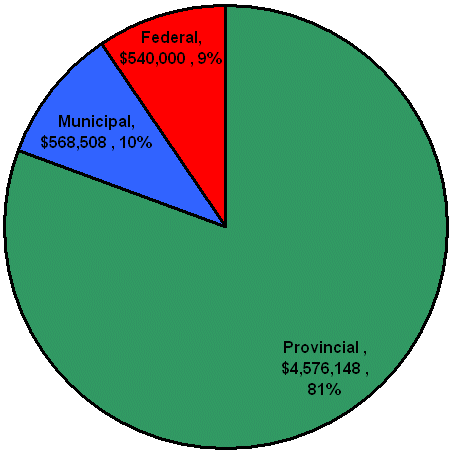
The Town of St. Anthony will construct a regional civic centre, to be called the Polar Centre, with a contribution of $4,576,148 from the Government of Newfoundland and Labrador, and an investment of $540,000 from the Atlantic Canada Opportunities Agency (ACOA). [i.e., from the federal government.]

[...]

The facility will house an arena with the capacity to seat 1,295 people, a conference centre and an indoor walking track, and will provide the necessary amenities to enable the town to host significant conferences, trade shows and other events.

[...]

The town will provide $568,508 towards the cost of the project.
For the less-mathematically and more-visually inclined, here are those figures again, in a handy-dandy pie chart, showing the dollar figures of each government's contribution, as well as the percentage each order of government is putting towards the total:

Note two very interesting things:

One, the provincial government is picking up by far and away the majority of the Polar Center's costs, 81%.

Two, and more subtly, even the municipal share of the project is even larger than the federal one.

Now, contrast the provincial government's willingness and ability to do for St. Anthony — build a public cultural and events space — with what it is evidently not willing to do for Happy Valley-Goose Bay.

During the 2005 federal by-election, Chairman Dan penned the following non-sequitur appendix to a letter on military issues, in a not-so-subtle attempt to elect a Conservative (Danny was still a federal Conservative back in those days; only Mrs. Danny and His hairdresser know for sure what he might be now):

May I also take this opportunity to highlight for you our recent efforts on another issue of importance to the people of the region - namely, the request for a new auditorium. My Minister for Labrador Affairs and Tourism, Culture and Recreation, Paul Shelley, was just in Ottawa where he spoke with his federal counterpart on this matter a number of times. A senior member of my staff has also raised it directly with the Prime Minister’s Office. With a federal by-election looming in Labrador, federal parties are paying closer attention to Labrador’s unique needs and considering ways that Ottawa can do a better job of addressing them. This is the ideal moment to draw attention to these needs and to propose solutions. Our government is endeavouring to work collaboratively with the Government of Canada to identify ways for the federal government to bear the majority of the costs of an auditorium project.

[Emphasis added.]

The public also learned, through sources like other ITAR-DAN press releases, that

Government is announcing a $1.9 million provincial contribution to proceed with performance space in Happy Valley-Goose Bay. Government will continue to explore a partnership with the federal government to share in the total project cost estimated at $4 million.
And that:
Government is moving forward with construction of the $4 million Mealy Mountain Auditorium.

[...]

In March, the Provincial Government committed $1.9 million to fund construction and is confident further federal funding will be approved in the near future.

And especially that:

DLAA acted as the coordinating body for Government and approached various federal Ministers, requesting their assistance to secure federal funding for the auditorium. DLAA, in cooperation with various provincial departments, continues to research options to determine the most viable location for an auditorium to ensure that public infrastructure needs are met in the most cost effective way for the provincial taxpayer.

[Emphasis added.]

Translated from the Danny-ese: "that public infrastructure needs in Labrador are met in a way such that as much of the cost as humanly possible is shifted from Her Majesty in Right of Dannyland, to Her Majesty in Right of Canada."

Surely, if the provincial government has $4.5-million in election-year money for St. Anthony, it is not a question of money that is preventing it from putting more than $1.9-million — and that is dependent on federal matching funds to boot — into the Labrador auditorium. If Danny's government can afford, politically speaking, to put in 81% in St. Anthony, or, conversely, if just 9% federal money is acceptable, then the same formula ought to be available to a Labrador municipality, no? All one province... right?

And surely, given Danny's stated philosophy, as expressed on the night he became The Party's The Leader:

It’s high time that Labradorians, instead of feeling like someone else’s treasure trove, started feeling like an integral part of our province. We cannot expect fair treatment from Ottawa if we don't practise what we preach.

it is not a question of fairness. Danny solemnly swore to be fair to Labrador, to treat Labrador like "an integral part of the province". Surely Danny is treating St. Anthony and Happy Valley-Goose Bay equally "fair", even if it's in some subtle way that mere mortals cannot fathom.

But has Danny, or anyone in his government, ever stopped to consider this:

When their definition of "fair treatment" for Labrador seems always to be entirely contingent on getting enough money from that horrible, nefarious, insidious Ottawa to practice their "fairness" with; even as their own same government does unto St. Anthony — "bears the majority of costs" — that is evidently a federal responsibility north of the Strait of Belle Isle, can it then truly be said that they are treating Labrador like "an integral part of the province", or that "we practise what we preach"?

All parts of the province must, in the Dannyverse, be treated fairly. To do less, would be to not practise what one preaches.

But somehow, in this same, ever-so-fair Dannyverse, while all parts of the province are treated integrally, some are treated more integrally than others. Just three years into the Danny Williams Revolution, and already the revolutionaries are practising Animalism.

The question, then, for Jack Byrne, Danny Williams, and others in this, The Fairest Government In The History Of The Universe, must be:

What on Earth or in Dannyland distinguishes the Polar Centre in St. Anthony from the Mealy Mountain Auditorium in Happy Valley-Goose Bay, other than the fact that the one is in Newfoundland, and the other is in Labrador?

Are "We" really, truly, honestly practising what "We" preach?

Sunday, January 21, 2007

Back to the Future with your host Bill Rowe

Having proposed in past runnings of his Weekly Hate, inter alia, that Quebec should separate from Canada ("We love you Quebec but please leave", April 16, 2005); that Newfoundland should separate from Canada (every other week, basically, but if you want a specific cite, try "An independent Newfoundland and Labrador", June 18, 2005); that Labrador should separate from Newfoundland ("Should Labrador separate?", May 28, 2005); that the provincial capital should be moved to some location in the central part of "the province" ("It's time to shut down St. John's", July 2, 2005); and goodness knows what else; and having, on the airwaves of the Daily Two-Hour Hate, fustigated Quebec over the supposed Labrador boundary "dispute" (passim), and even suggested Quebec be kicked out of Canada (ibid.); now comes the Republic of Newfoundland's former Ambassador to Canada, Comrade Bill Rowe, and his latest brain fart in the Saturday pages of The Telegram:

Time to get in bed with Quebec?

[...]

Does the idea of Newfoundland and Labrador joining the Maritime provinces look geographically natural to you? Not only do we have little in common with them culturally, but even the geography of such a union looks weird to me.

Now look at that map again. Doesn’t it strike you that geographically we have an awful lot in common with Quebec? Labrador is the same land mass, and Newfoundland, just a few miles away across the Strait of Belle Isle, is a very natural extension.

In which literary effort Comrade Rowe laments:

Quebec forges ahead with another multibillion-dollar hydroelectrical project while our Lower Churchill stays stuck in neutral.
without investigating why "our" [sic] "Lower Churchill" [sic] is stuck in neutral. Is it Canada's fault? Quebec's? Any chance, however slight, that it might be "our" own? Who knows; Comrade Rowe raises the question, but runs away from the answer. Hard-hitting stuff!

Comrade also whines:

Every redistribution of seats in the House of Commons will increase the number from the rest of Canada while leaving us with our paltry seven.
without noticing that, as a region of declining population within a united province of "Quebec and Newfoundland", Newfoundland and Labrador and would lose the "paltry seven" representation it is currently guaranteed as a stand-alone province. (Or, for that matter, that only three provinces in "the rest of Canada", as of late, have been increasing their representation; the other six being in exactly the same position as "us". Or that the ONLY province which has never, ever lost a seat in redistribution is... Province No. 10!) Regions within provinces do not have the same protection against seat loss that provinces do.

Example: In Quebec, from Lévis to les Îles inclusive, there are now five federal electoral districts: Gaspésie—Îles-de-la-Madeleine; Haute-Gaspésie—La Mitis—Matane—Matapédia; Rimouski-Neigette—Témiscouata—Les Basques; Montmagny—L'Islet—Kamouraska—Rivière-du-Loup; and Lévis—Bellechasse.

In this same space, as late as the mid-1960s, there used to be ten: Bellechasse; Bonaventure; Gaspé; Îles-de-la-Madeleine; Lévis; Matapédia-Matane; Kamouraska; Montmagny—L'Islet; Rimouski; and Rivière-du-Loup—Témiscouata. Les Îles, Gaspésie and the Bas-Saint-Laurent regions in Quebec, among others, have been experience population decline on similar orders of magnitude as rural Newfoundland... only it started much earlier.

(Contrary to popular myth in Newfoundland, the provincial population increased dramatically in the post-Confederation years, growing at roughly double the pre-Confederation rate, and despite the recent population loss, is still much higher than it was in 1949.)

As part of a united province of Quebec and Newfoundland, the area formerly known as Newfoundland and Labrador would be entitled, under the electoral boundaries legislation, to five ridings. Assuming for the sake of argument that recent demographic trends continue unabated, by the 2080s, Newfoundland would be down to a single MP.

Comrade Rowe also asks:

Do you think Ottawa would say no to fallow field legislation for our offshore resources if Quebec was asking for it?
Perhaps Comrade Rowe should have asked, what jurisdiction does Quebec exercise over offshore petroleum exploration in the Gulf of St. Lawrence? Or over any activity at all in Hudson Bay and Strait? How does that jurisdiction compare to what the current province of Newfoundland and Labrador has under the Constitution, according to the courts, and under the Atlantic Accord? And how does that answer square with the Quebec-tail-wagging-the-dog conspiracy?

Finally, Comrade Rowe gushes:

Add to that magnificent mix our half million feisty, brainy people with our resource-rich land mass surrounded by a resource-rich ocean, and the united province of Quebec and Newfoundland would be unstoppable in Canada and the world.
Maybe it's Comrade Rowe who needs to look more closely at maps.

While most of "our half million people" may be "surrounded" by an ocean (and it's less than half a million once you account for "our" people, the 30,000 or so, who are not surrounded by water), most of "our resource-rich land" — you know, the chunk that contains "our Lower Churchill", and, presumably, "our Voisey's Bay", "our iron ore mines", "our spruce forests", and whichever else of "our" Labrador resources strike the fancy, from time to time, of the Newfoundland nationalists — is firmly attached to the continent.

No one has yet dug a canal along the Labrador-Quebec boundary. "We", as a province, are NOT surrounded by an ocean, resource-rich or otherwise, even if that island to the south of Labrador is.

So, having condemned Quebec on many occasions, sometimes passim, sometimes more forcefully, for its supposedly wanting to change or erase the Labrador boundary, it is now Comrade Rowe himself who proposes pulling out the giant eraser, wiping the 1927 line off the map, and uniting not just Quebec and Labrador — an idea which he used to bristle at — but Quebec, Labrador, and that island to the south of Labrador to boot!

And, as it turns out, the idea of uniting Quebec and Newfoundland into one jurisdiction is actually not original, or even new. It is very old. It was proposed in the 1860s that "Canada East" and Newfoundland be merged into one, "unstoppable", sub-national jurisdiction.

The proponents? American Annexationists.

ARTICLE III
For all purposes of State organization and representation in the Congress of the United States, Newfoundland shall be part of Canada East, and Prince Edward Island shall be part of Nova Scotia, except that each shall always be a separate representative district, and entitled to elect at least one member of the House of Representatives, and except, also, that the municipal authorities of Newfoundland and Prince Edward Island shall receive the indemnities agreed to be paid by the United States in Article II.
It was a loopy idea from them, then. It's a loopy idea from Comrade Rowe, now, and that's probably the point. Comrade Rowe is a one-man loopy idea conglomerate, overly fond of his own brain farts and the sound of his radio voice. "Uh huh, uh huh," he grunts disinterestedly at half of the callers — it IS a call-in show, Bill! — to the Two-Hour Daily Hate; usually just before he bellows at them, "WHAT IS YOUR POINT?"; oblivious to the fact that the listening audience, who are actually, you know, listening, know full well, nine cases in ten, what the caller's point is.

Moderator, Moderate Thyself!

But if this "column" is the sort of thought experiment that Comrade Rowe must engage in, to decide for himself, once and for all, whether he's a Federalist, Separatist, or just a Contrary Old Jackass, he should keep 'em comin'.

If nothing else, they are of great infotainment, and historic, value. Who knew the American Civil-War era Annexationists were on to something?

Saturday, January 20, 2007

Quick! To the patent office!

From the Ministry of Truth today:
Ruling Out A Spring Election
January 20, 2007

Premier Danny Williams has ruled out a spring election. With a rash of resignations in the House of Assembly and the cost of byelections, Williams was asked yesterday if the October general election might be moved up. He says no. Williams says it was decided there would be fixed elections to give certainty to the public and to prevent oppurtunism by a government. He says it would be two-faced of the government to turn around and do otherwise.
Spec! Tac! U! Lar!

On this issue, Danny says he will keep a political promise, because to do otherwise would be "two-faced".

Yet, on another issue, and another promise, Danny has no qualms whatsoever about being "two-faced". Quite the double-standard.

Yes, folks, Danny is being two-faced about being two-faced.

Doing his part for the knowledge economy, Danny Williams has invented meta-two-facedness!

As a Great Lawyer™, he will need no reminder about the need to rush posthaste to the Patent Office. Perhaps the Embassy can handle the paperwork.

Another question for Sue

When you say "take the Flag down for Good", what are you getting at?

Reply comments welcome, even, especially, from Sue.

An exercise in closed government

Can anyone figure out why the report of the provincial Electoral Boundaries Commission is treated, even if only for a little while, like some secret of state? At the federal level, the reports of each of the ten provincial Electoral Boundaries Commissions may be made public on up to ten different days, but neither MPs, let alone the government, are given advance copies.

The provincial E.B.C. submitted its report to the provincial Minister of Justice on November 30th. What sound policy purpose is served by keeping it away from the prying eyes of MHAs until January 19th, and longer still from the eyes of the public?

For that matter, why does the provincial Electoral Boundaries Commission even report to government anyway, instead of to the Chief Electoral Officer and the Speaker, as is the case federally?

(Yeah, yeah, "We are going to stand on our own and (inaudible)." We all get it, Danny. Canada sucks, P.W.G., rah rah rah, blah blah blah.)

Still, this rule long pre-dates Danny Williams. Why isn't the Electoral Boundaries Commission held, by statute, at a longer arms' length from the government of the day?

Upon further investigation

Further to "The other way to square the circle", it would appear that five other provincial and territorial jurisdictions, besides Nunavut, Ontario, Prince Edward Island, Saskatchewan , and the federal government, have enacted legislation which avoid the necessity of by-elections in the last year (or so) of a legislature's constitutional or statutory term.

Such provisions are also to be found in s. 32(3) of the Alberta Legislative Assembly Act; s. 130 of the Quebec Election Act; s. 10(2) of the Nova Scotia House of Assembly Act; s. 18 of the Yukon Legislative Assembly Act; and s. 11(2) of the NWT Legislative Assembly and Executive Council Act.

In other words, it is the standard practice, in almost every one of the fourteen Canadian jurisdictions, to avoid by-elections in the dying days of a legislature's general election mandate — a fact that can be gleaned in about fifteen minutes on Google.

If only The Great Lawyer, or the House of Assembly as a whole, had done their homework (and their job!), and properly investigated all the implications of fixed-term elections prior to rubber-stamping one of Great Lawyer's bills, including looking at the practice in other jurisdictions, then there might not have been this nasty little serial by-election problem that has thrown such a wrench into Great Lawyer's heartfelt desire to break his "fixed election date" promise and go to the polls early.

Friday, January 19, 2007

In Which Danny Channels Bill Clinton

"There is no spring election." — Danny Williams, on CBC Radio News, today.

"There is no sexual relationship." — Bill Clinton, 1998.
As Slick Willy went on to say, "It depends on what your definition of 'is' is."

There was a reason why witnesses in the McCarthy hearings were asked "Are you now, or have you ever been, a Communist?".

That reason is the multiplicity of verb tenses, and the tendency of lawyers to play with them.

The value of written promises

While Danny Williams publicly ponders the value of a written political promise, in the context of certain promises, pertaining to certain issues of fiscal federalism, made by the current Prime Minister, the Premier would do well to consider as well the value of written political promises made by members of his own provincial administration.

Written promises made by Danny Williams, for example:

At our meeting on Friday, September 12, 2003, I outlined a number of commitments a Progressive Conservative government would undertake with respect to the constitutional rights of the Metis people in Newfoundland and Labrador, and the involvement of the Labrador Metis in the benefits that would accrue from development of the Lower Churchill and other resources in the region. The commitments include the following:
•A Progressive Conservative government will acknowledge that the decision in the Powley case applies to Metis in Newfoundland and Labrador, and will participate with specific rights affirmed in the Powley decision and other rights protected under s. 35 of the Constitution.

•We will work in partnership with the Metis people of Labrador to promote and strengthen Metis communities and culture, and to ensure the Metis and all residents of Labrador share in the benefits that accrue from the development of Labrador resources.

•We will involve the Labrador Metis Nation, as we will representatives of all residents of Labrador, in the process of negotiating a Lower Churchill Development Agreement.
[…]

Sincerely,
DANNY WILLIAMS, Q.C.
Danny Williams should hold Danny Williams to account.

A promise, after all, is a promise.

Thursday, January 18, 2007

Can't fault'em for trying

Wonders will never cease! Hospitality Newfoundland and Labrador has finally broken its long public silence about Labrador marine transportation services. As Rosie Gillingham reports in Wednesday's running of The Telegram:
Ferry changes lacking: HNL president

The schedule for the Sir Robert Bond ferry has been released much earlier than usual, but don't expect to make bookings any sooner.

[...]

... Hospitality Newfoundland and Labrador (HNL) president Nick McGrath doesn't think it goes far enough.

He is concerned that while people can see the schedule, they cannot yet make reservations.

"People can make travel plans, but they can't move forward with those plans," McGrath said.

"If they're going to put the schedule out, it's important to have the infrastructure in place that you can act upon that and that's not the case here."
So far, so good. But wot's this now?
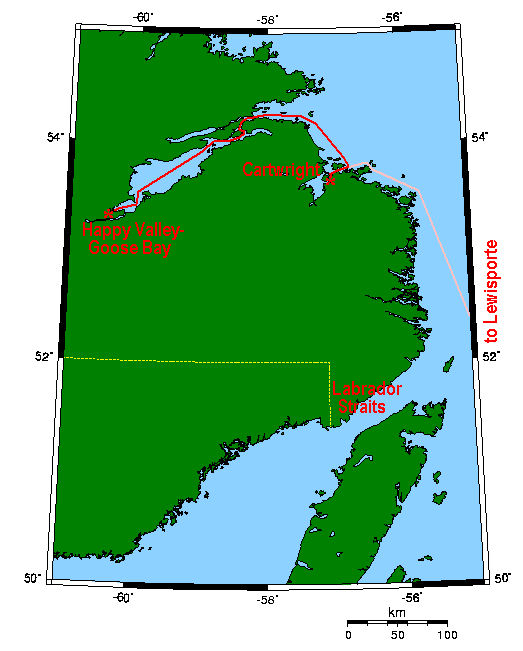
[McGrath] believes there should be more frequent runs between Happy Valley-Goose Bay and Cartwright and that the ferry times should change from night runs to day runs.

[...]

"The entry points or departing points at Happy Valley-Goose Bay are losing out. Businesses there are not reaping the benefits.

"Plus, people are missing out on all the natural beauty of the Labrador Straits because they're travelling it in the dark."
Yeek!

The Happy Valley-Goose Bay to Cartwright segment of the Sir Robert Bond's route passes through Hamilton Inlet and Sandwich Bay. Natural beauty? In spades and then some: the Mealy Mountains, Mokami, Highlands, the Narrows, the islands of Groswater and outer Sandwich Bays, puffins, grampuses, whales, George's Island caribou.

The Labrador Straits, however, is several hours' drive, and 150-ish miles, as the crow flies, south of Cartwright. The closest the Bond gets to the Labrador Straits is as it passes to seaward of Belle Isle on her way to and from Lewisporte.

Here, for HNL's benefit and that of the general blog-reading public, is an explicatory map (click on it to enlarge) with the Goose-Cartwright ferry route highlighted in red:

A point to ponder

If the provincial government's stance on Hibernia South is such a great thing; if it's such a great day; if it's the Fighting Newfoundlander Incarnate, Danny Williams, taking one for the good of The Nation of Newfoundland. and Labrador; if it's an historic moment of "no more giveaways"; a day for the ages; if it's Danny Williams once again taking a stand, basking in the love and adoration of the proles, as evidenced again today on The Many Different Ways In Which Danny Williams Is So Effing Awesome, With Host Bill Rowe...

...then why was it Kathy Blunderdale, and not Glorious Leader himself, who went before the cameras yesterday to announce it?

Wednesday, January 17, 2007

Promises, promises

In the 2003 provincial election, Danny Williams promised

A Progressive Conservative government will complete the Trans-Labrador Highway.
He did not promise

A Progressive Conservative government will complete the Trans-Labrador Highway if and when the federal government pays us to do it.
But that's all what he's offering:

Other road improvement plans include:
• $17 million for ongoing construction of Phase III of the Trans-Labrador Highway;
• $15 million to commence hard-surfacing of Phase I of the Trans-Labrador Highway – subject to cost-sharing with the federal government;
A "promise" or a "commitment" that is made contingent on someone else, other than you, doing something, is not a promise or commitment at all.

Given that the overwhelming majority of the funds that have ever been dedicated to building the Trans-Labrador Highway have come from federal coffers, the question must be asked: when is the province of which Labrador is supposedly a part going to kick in its share?

Danny Williams has become Brian Tobin and Roger Grimes; the Premiers whose governments one year promised:

"This compensation package makes it possible for the province to complete the Labrador West to Happy Valley-Goose Bay section, and a highway between Cartwright and Red Bay. However, it will not complete the link between Cartwright and Happy Valley-Goose Bay. The province will provide additional funds to complete that portion of the road[.]"
and then turned around and passed the buck:
"We have requested the federal government enter into a cost-shared funding agreement to complete Phase III, but we have not yet received a favourable response. We have gone on record as saying that the Trans Labrador Highway is the province’s number one priority, and we made a commitment to the people of Labrador that we would find a way to complete Phase III. Today I am pleased to say we will live up to that commitment."
Living up to a commitment by breaking it, is to have no committment at all.

In his coronation speech as PC Party leader, Danny Williams said:

It’s high time that Labradorians, instead of feeling like someone else’s treasure trove, started feeling like an integral part of our province. We cannot expect fair treatment from Ottawa if we don’t practise what we preach.
How's that going, anyway?

If Danny Williams is so "committed" to Labrador, and to the completion of the Trans-Labrador Highway, why can't his government start paving the road with or without federal money, and without prejudice to any future federal-provincial highways agreement?

Doesn't Labrador pay provincial taxes and contribute other provincial revenues?

Is Labrador part of a province? An integral part?

If so, which one?

If it is, and if it's so very integral, why do the Sun King's solemn promises and firm commitments come with federal strings attached?

When it comes to Labrador, when is Danny ever going to practise what he preaches?

One thing He's not

Danny Williams, when it suits him, likes to think of himself as the federal, provincial, local, executive, legislative, and judicial orders and branches of government rolled into one.

In all fairness, though, there is one government official, though, that Danny Williams definitely is not.

Danny Williams is not the minister who ever delivers bad news.

He is the Sun King. Let the others have exclusive jurisdiction over rain.

Tuesday, January 16, 2007

The Trans-Labrador Information Highway

The provincial tourism information website has long since started to look and feel "quaint". It's a stretch of the information highway with more ruts and potholes than its Trans-Labrador gravel equivalent. And it seems people are really starting to notice. From the CBC today:
Tourism operators in Newfoundland and Labrador say outdated listings and information on the provincial tourism department's website could hurt their bottom line.

Linda Green, who operates Bradley's Bed and Breakfast in Happy Valley-Goose Bay, said potential visitors could be deterred from planning a vacation because they cannot obtain accurate information online.

[...]

Some events listed, for instance, actually took place 2006, while events planned for 2007 have not been added.
Yes, you've seen this movie before. From the June 1, 1998 running of The Telegram's Cheers and Jeers entertorial*
JEERS: The Newfoundland government tourism Web site is a tad outdated -- the bulk of the material on the site consists of last year's Cabot 500 celebrations. When the province revised its Web site this past year, it neglected to do anything with the tourism portion of the site.

The worst part about it is that Web sites are not difficult or expensive maintain, despite what Tourism Minister Sandra Kelly might say to the contrary. Any high school kid with a basic understanding html coding (the language of the Internet) can design and maintain a site. So why can't the provincial government maintain a first-rate tourism site? At the very least, the department should get of the obviously outdated 1997 material.

Here's an suggestion: How about putting the entire accommodations book on-line? That's the most valuable information a tourist can get.
The only problem with the latest report of "cobwebs" is that it comes out of Labrador... which will make it so much easier for Hospitality Newfoundland and Newfoundland, and the Newfoundland and Newfoundland Department of Tourism, to ignore it.


-----

* (wow... they've been cheering and jeering that long already?)

Facts and figures

And again this week, The Independent puts on a stunning exhibit of its crackerjack research skills. As Ryan Cleary columnizes:
Incidentally, when Newfoundland joined Canada in 1949, we had 36 MHAs and a population of around half a million. Our population today is about the same, with 48 MHAs.
In the last pre-Confederation census of Newfoundland and Labrador, in 1945, the population was 321,819. In the first post-Confederation census of Canada, in 1951, the new province's population was 361,415. Interpolating for 1949 gives you a ballpark figure of 350,000, which, as it turns out, was also a frequent estimate used by the press reporting on the entry of the new province in 1949.

If 36 MHAs was appropriate for the 1949 population, which was roughly 350,000, then, measured per-capita, the current population should mathematically merit 52 — the size of the House of Assembly before the redistribution of 1996.

The other way to square the circle

So the Premier is willing to amend the law if the October 9th, 2007 election date, that his government set down, is no longer convenient. As Rob Antle reported for The Telegram last week on the 7th:
A law passed by the Tory government in 2004 set the next election date for Oct. 9, although the lieutenant governor can choose to dissolve the legislature at any time.

Williams indicated he would recall the House to change the law if he decides an election is necessary before then.
Hmmm.

If Danny Williams suddenly finds himself concerned about the expense and inconvenience to the electorate of having a batch of three (or more) by-elections this spring, then the regularly-scheduled general election this fall, and if he is keen to change the law to fix this "problem"...

... then why not change this section of the House of Assembly Act:
Writ of election
54. Where a vacancy occurs in the House of Assembly, the Lieutenant-Governor in Council shall, within 60 days after the seat becomes vacant, issue a proclamation for the holding of an election and return of a member for the district in respect of which the vacancy has occurred.
which, after all, his own government instituted in 2004 in the fixed-election bill itself?

It is passing strange that such a Great Lawyer didn't have the foresight to include in his brand-new s. 54 a provision that would obviate the need for a by-election to fill a vacancy in the final year of a government's general election mandate.

Such provisions are to be found in s. 38 (2) of the Nunavut Elections Act, s. 27(2) of the Ontario Legislative Assembly Act, s. 5.1(2) of the Prince Edward Island Elections Act, s. 46(2) of the Saskatchewan Legislative Assembly and Executive Council Act, and s. 31(2) of the Parliament of Canada Act.

Now Danny's allergy to anything and everything federal and Canadian — other than federal transfer payments and federal government spending — is well-established:
I am sorry, Sir, I am just not going to follow what the Government of Canada does. We are going to stand on our own and (inaudible).
But surely to goodness some member of the House of Assembly could have seen this issue coming, and examined other Canadian jurisdictions for tips on how to handle it.

Perhaps if Bill 40 had spent more than six calendar days getting from the start of second to the end of third reading, and perhaps if it had been referred to a real committee instead of the Whole, one of them might have.

Monday, January 15, 2007

A dismal heritage moment

In a successful attempt to preserve and promote the cultural heritage of Newfoundland and Labrador, the provincial government once again exhibits all of the exemplary administrative and constitutional professionalism that 1930s could offer.

From the Ministry of Truth:
Chief Electoral Officer Anticipates More MHA Resignations
January 15, 2007

Chief Electoral Officer Chuck Furey says he's been advised that more MHA's may be vacating their seats in the House of Assembly prior to the provincial election in October. Furey is already preparing for upcoming byelections in Kilbride, Ferryland, and Port au Port and says more may be coming. Furey estimates the provincial general election will cost about 4 million dollars and says the by-elections will be expensive. He says the three byelections so far will cost well over 3 hundred thousand dollars. Meantime, Furey says he doesn't know yet whether Premier Danny Williams will change the electoral boundaries this year.
Interesting use of the passive voice there. "Been advised" by whom?

It is of dubious propriety that the Chief Electoral Officer would be notified of possible vacancies in the first place.

It is of no propriety at all that he would blab about it.

Then again, it's also of no propriety at all that an ex-partisan would be appointed Chief Electoral Officer in the first place.

Then again again, it's also of no propriety at all that he would engage in politics from his impartial, non-partisan, apolitical office.

Then again again again, this is also the same government that considers "all-partisan" to constitute non-partisan. (Boy, did that ever work out.)

Where's Duff Conacher when you need him?

Sunday, January 14, 2007

Move over Joe Stalin!

The word "Sovietesque" is hereby abolished.

After his latest performance, pledging fealty to Dear Leader on the Ministry of Truth tonight, this blog is pleased to give you... "Oramesque"!

A tale of three rivers

Today's Telegram editorial raises — finally — an enduring mystery.

Where are all the local environmentalists?

The editorial discusses the Quebec plan to go ahead with the damming of the Rupert River, discussing the controversy and voices of dissent, concluding:
...it was poignant because it’s a voice we don’t often hear, certainly not in this province.

Hydro in Newfoundland and Labrador means the Upper and Lower Churchill, and is often discussed solely in terms of power and politics.

There are people there, too — people to whom dams and turbines spell not progress and power, but destruction and death. You have to listen carefully to hear them, but when you do, their story is powerful and troubling.

And eye-opening.
It wasn't until this past week that Grand Riverkeeper, one of the few voices in this vein that there even are to be listened to, managed to get any significant pan-provincial media attention. After years of being (literally) a voice in the wilderness, they could only get their message across, despite all the modern technology, by taking it directly to the media capital of the universe, St. John's.

Local attitudes towards environmental stewardship leave much to be desired. Wildlife management, for example, is centred around protecting the edible species from the inedible (or less edible), the commercially-valuable from the market-less (or less commercially-valuable). If a species is in decline, the four-legged predators are too often the fall guy even when there is probably a goodly share of moral culpability that could be assigned to the two-legged ones.

(It's surprising that a four-legged scapegoat, scapemoose, scapebeaver, or scapesomething hasn't yet been found for over-cutting of pulp logs, or the ATV scarring of marshlands that's so evident as you fly over Newfoundland.)

To the extent that there is a local environmental movement, too often it is focussed on international issues rather than local ones. It's easy enough to get 12,000 signatures on a petition to stop a hydro project in Central America. Or 30,000 protest letters. Or to call it "the BRINCO of Belize".

How many of them, though, would dare publicly question the environmental impact of the so-called "Lower Churchill" project?

Yo, Greg Malone... where are you? What about the "BRINCO of Labrador"?

Macal, Rupert, Grand.

You have to listen carefully, indeed.

Busted!

A long time ago, someone decided, erroneously, that Newfoundland is the tenth-largest island in the world.

It isn't. But that hasn't stopped this "fact" from becoming "fact", in Newfoundland anyway.

This myth needs some serious busting.

For the record, here are the sixteen largest islands in the world, with their areas in square kilometres:
1 Greenland — 2,130,800
2 New Guinea — 785,753
3 Borneo — 748,168
4 Madagascar — 587,713
5 Baffin Island — 507,451
6 Sumatra — 443,066
7 Honshū — 225,800
8 Great Britain — 218,595
9 Victoria Island — 217,291
10 Ellesmere Island — 196,236
11 Sulawesi — 180,681
12 South Island of New Zealand — 145,836
13 Java — 138,794
14 North Island of New Zealand — 111,583
15 Luzon — 109,965
16 Newfoundland — 108,860
And oh yeah — not only does Stephenville not have the longest runway in Canada, it doesn't have the longest in Canada, or the province, or even in Newfoundland. Sorry.

Saturday, January 13, 2007

...and broken records

Certain provincial politicians, who should know better, have recently repeated the lie — and it is a lie — that the House of Assembly Act (sometimes it's erroneously given as the Elections Act) would have to be amended in order to legally allow Chairman Dan to break his solemn 2003 campaign promise (supra) of fixed election dates.

And certain reporters, at last count three of them, have swallowed this line, hook, and sinker, and repeated, like a broken record, the misinformation that such a legislative amendment would be necessary.

It would not.

As the late Jack Harris pointed out in debate on the "fixed election" bill on December 7, 2004:
We heard comments yesterday from the Premier talking about notwithstanding clauses, how they might be used, how they might have effects on what might happen, notwithstanding clause having the ability to overrule everything else that is in the piece of legislation. What do we have here? "Notwithstanding subsection (2), the Lieutenant-Governor may, by proclamation in Her Majesty’s name, prorogue or dissolve the House of Assembly when the Lieutenant-Governor sees fit."

Who does the Lieutenant-Governor take his advice from? He takes it, I think, from the Lieutenant-Governor in Council, the Cabinet, the Premier. I guess it depends on what kind of advice the LG is going to get, then.

What is the point of a fixed date, four years, if, under this section, the Lieutenant-Governor is still required to take the advice of the Lieutenant-Governor in Council as to when he calls an election?

[...]

What if the Premier gets up some morning and decides, I want to have an election next month? He does not have to wait. There is nothing that I see in here that prohibits the Premier, the Lieutenant-Governor in Council, from telling the Lieutenant-Governor to call an election.
Prescient words. Possibly a little too prescient.

The text of the Bill itself, and the House of Assembly Act as thereby amended, provide:
Duration of House of Assembly
3. (1) Notwithstanding subsection (2), the Lieutenant-Governor may, by proclamation in Her Majesty’s name, prorogue or dissolve the House of Assembly when the Lieutenant-Governor sees fit.

(2) A polling day at a general election shall be held on the second Tuesday in October, 2007 and afterward on the second Tuesday in October in the fourth calendar year following the polling day at the most recently held general election.
See?

Reading between the constitutional lines, "when the Lieutenant-Governor sees fit", translated from Westminsterese to the real world, means "when the Premier sees fit". Chairman Dan already has the power, under s. 3(1), to cynically break his "fixed election" promise. The election date is only as "fixed" as Chairman wants it to be.

Any reporter or political panellist who has trouble understanding this should get it explained to them by a good lawyer, not by The Great Lawyer.

Go ask Jack Harris.

Fixed elections...

Hints and speculation continues to mount (like here, here, and especially here and here) the We are going to break another of Our promises, and, fixed-election legislation be danged, We are going to pull a Tobin (Peckford, Smallwood) and dissolve the legislature less than 3.5 years in.

Should that Tobin get pulled, here, for the record, is what Chairman Dan and The Party used to say about the virtue of fixed election dates:

"We are now within one year of the next general election," said Williams. "For the first time in our province's history, everyone knows well in advance exactly when the next general election will be held, and that is because we kept our Blueprint promise to establish fixed election dates through legislation to ensure greater openness and transparency."
- From a The Party press release which may or may not still be available at: http://www.pcparty.nf.net/200610101.htm
MR. SULLIVAN: Went out in the last election, out there, going down through his district, and almost got run over with a spreader and so on, trying to (inaudible) some pavement to get him the fifty votes he needed to get him into office. That is what happened. That is what he did. That is the type of politics they play.

We have laid out fixed elections. We are not going to manipulate them when the poll is high. We are not going to manipulate them when the poll is high and run to the polls. We said that the people will have four years to judge us.
- House of Assembly Debates (Hansard), May 18, 2006
MR. WISEMAN: As the former speaker and the Leader of the Opposition points out, there are three separate pieces of this legislation and I want to comment on the three of them if I could. The first one, being fixed terms, is obviously a significant issue. If you look at the history, and most recent history, of elections in Newfoundland and Labrador, we saw, in a period of 1993, 1996, 1999, rapid successions and rapid calls of elections.

Mr. Speaker, in each of those election calls there was a significant amount of staging, a significant amount of manipulation that took place in advance of those elections. One could say that it was a manipulation of the electorate.

This particular provision in this bill very clearly now forces a government, any government, whether it is this government today or some future government, it forces government to focus on governing the Province and not positioning itself for an election, or continuously thinking about how it might be opportunistic and call an election at a time when it suits their circumstance best. I think that is the significant issue with respect to this particular component of this bill. It now forces government to focus on a mandate that we all now know will be four years. We know today that on October 9, 2007, the people of the Province will be going to the polls again. This government recognizes that, the Opposition Party recognizes that, but, most importantly, the people of Newfoundland and Labrador recognize that.

As a government, our responsibility is to provide good, sound, governance today, create legislation that reflects a progressive government, reflects the protection of the people of this Province. That is what our responsibility is, and that is what our focus will be. We are not, today, thinking about whether or not we have an opportunity today to call an election.
- House of Assembly Debates (Hansard), December 7, 2004
The party in power always has an advantage in political fund raising, but it has an unfair advantage over other parties by being able to determine when elections are called, and by spending unlimited amounts of public money to buy pre-election advertising that does nothing but polish its political image.

A Progressive Conservative government will propose amendments to the Elections Act and other relevant acts that will:
Require that provincial elections are held on a fixed date every four years, or immediately if a government loses a confidence vote in the House of Assembly, or within 12 months if the Premier resigns during the first three years of a four-year term.
- From The Party's 2003 election platform, which may or may not still be available here: http://www.pcparty.nf.net/plan2003g.htm

Finally, from a long-since bit-bucketted, but well-archived The Party press release, dated February 5, 2003 — should we circle that date, February 5? — comes this gem:
B. Effective Government

We also have seen problems arise over timely elected representation. There have been numerous situations over the last few years in which the electorate has gone unreasonable periods of time without elected representatives. In fact, one district did not have representation for the entire Voisey's Bay debate, which was one of the most important debates that occurred in this province last year. We have an ongoing situation in which the Premier has governed the province for two full years despite the fact that the people of Newfoundland and Labrador did not have the opportunity to elect him. And we have situations in which individuals are not able to obtain information from their government because of countless restrictions and excessive wait periods. This is wrong.

A Progressive Conservative Government will address these issues decisively.

We will amend the Elections Act to require that provincial elections be held on a fixed date every four years, or immediately if a government loses a confidence vote in the House of Assembly.

The legislation will ensure that, if the Premier resigns or the Premier's office is vacated within the first three years of a term, an extraordinary election will be held within twelve months and a new government will be elected to a fixed four-year term.
To boot, this document also includes this now-quaint throw-away line:
We will establish a new procedure to provide for the proper auditing and disclosure of the expenses of Members of the House of Assembly.
As well as this howler:
We will amend the Access to Information legislation to enhance the transparency of government actions and decisions.

Our legislative changes will clearly identify information that should be in the public domain, and will require full and prompt disclosure of the information to the public. The Access to Information legislation proposed and passed by the Grimes government in 2001 (though it has not yet been proclaimed) allows the government to exclude a great deal of information from release to the public under the umbrella of "cabinet confidences". We will limit that exemption so more information that rightly belongs in the public domain will be accessible to the public.

Also, the legislation will be changed so any information that continues to fall under the umbrella of "cabinet confidences" will be released earlier.

We will enact changes to tighten up the exceptions to the release of information.

We will remove provisions that allow the cabinet to override the legislative provisions of the Act by regulation at their discretion.

Finally, we will shorten the time lines for the release of information so information that rightly belongs in the public domain is available to the people of the province on a timely basis. Access delayed is sometimes access denied.

Friday, January 12, 2007

Weather whoopsie

Yesterday, Comrade Rowe was positively gushing during the Two-Hour Hate, remarking how astoundingly accurate the weather forecast was, 24 hours after it resumed coming from Gander, rather, he sneered, than from up in Halifax, Canada.

Today, the Ministry of Truth ran this somewhat more subdued, less exhuberant report:

Storm Peters Out
January 11, 2007

We could call it the storm that wasn't. The fact of the overnight snowfall was considerably less than the 20 to 25 cms forecast yesterday. Meteorologist Jason Shepperd at the Gander Weather Office indicated it was difficult to guage the track of the storm. He says about 10 to 15 centimetres fell on the Avalon for the most part, a little more in some areas. He says the storm tracked a little more east than expected. The gusting winds in the forecast also failed to materialize.
But of course Comrade Rowe could be foregiven for deluding himself, if only briefly, into thinking the quality of the forecast depended so heavily on the location where it was teletyped from.

After all, as the Prime Minister, the guy that Comrade Rowe and Glorious Leader shilled for in the last election, said last year:

For years now, this province has had to endure inaccurate weather forecasts from nearly a thousand kilometres away in the Maritimes... Particularly affected by inaccurate forecasts are the thousands of Newfoundlanders and Labradorians who work offshore... Newfoundlanders and Labradorians deserve better than to be told to expect five centimetres of snow over night only to wake up to ten times that amount.
The VOCM report sounds suspiciously like the media reports that were so frequent after the forecasting service was moved to Halifax in 2003. What the Ministry of Weather ordered, and what was delivered, were two different things. Anecdotally, some people thought that there was something bad about the Halifax forecasts, even in the face of meteorological reviews that found otherwise:

Environment Canada says its forecasts for two Newfoundland regions were on target this summer, despite a popular perception that its weather reports are often overcast with errors.

[...]

The Conservative government is the process of restoring public and marine forecasting at Gander, prompted by a petition that attracted 125,000 signatures, including Stephen Harper's, then the leader of the opposition.

The campaign picked up its greatest momentum when Environment Canada missed storms that dumped dozens of centimetres on snow on unsuspecting towns, or called for a blizzard that never materialized.

"I'd be surprised," said St. John's resident Jason Esdon, reacting to Environment Canada's accuracy statistics. Esdon feels that forecasts are correct only half the time.
The notion that the forecast is dependent on the location from which it is made is received truth.
Gander Mayor Claude Elliott said forecasting based in Gander will benefit the entire province.

"Safety is the biggest concern," Elliott said Tuesday. "I think we need that brought back so we can be more accurate because the weather changes so much in this province, that you have to be here to witness it."
And Harper himself bought that idea, if only for political expediency:

"We are deeply concerned about the safety of fishermen and all who work on the water or in the air," Harper said.

The Liberals cancelled forecasting in Gander. They moved marine forecasting to Halifax, 1,150 km away, and aviation forecasting to Montreal, 2,220 km away.

"Inconsistent forecasts and bad forecasts are more than a nuisance," Harper said. "They endanger the lives of people who work offshore, and that is unacceptable. The Liberals simply don’t understand that weather forecasting in this province is unique."
Never mind that Harper got the geography wrong. Or that agencies like the US Army and Navy have no problem generating forecasts for every continent and ocean from home soil. Halifax is just too far.

It is about 290 miles, as the crow flies, from the former met office in Halifax — Dartmouth, actually — to the closest point in Newfoundland, Cape Ray, near Port aux Basques.

And 290 miles, it turns out, is also the radius of the circle on this map:

That little red cross in the centre?

That's Gander.

If Halifax is too far from Newfoundland to accurately forecast the weather for any point in Newfoundland, even Cape Ray, does it not also mean that Gander is too far to forecast the weather for all but the southeastern extremity of Labrador? If proximity matters, then ask, should Halifax or Gander be issuing the forecast for Labrador City and Wabush, bearing in mind that the latter towns are geographically closer to the Dartmouth office than they are to Gander?

As the Prime Minister said last year in his "Newfoundlanders and Labradorians deserve better" speech:

What is relatively new though is scientifically accurate weather forecasting technology — a technology our government believes the people of Newfoundland and Labrador should be able to benefit from.
Weather forecasting has always been, and likely always will be, a blend of art and science. But as new technologies are deployed on the ground, on the oceans, in the atmosphere, and above it, and as new computing hardware and methods are developed to crunch and model the data, it's increasingly a science.

Anton Chekhov said, "There is no national science, just as there is no national multiplication table; what is national is no longer science."

When it comes to the science of meteorology, Gander is no worse a location than Halifax to forecast the weather in Nain; Gander residents are no worse at doing it than Montrealers. But, setting aside the politics, scientifically, it is no better. The Gander weather office could just as easily have been relocated to Stephenville or St. Anthony or Wabush.

However distinctive or fickle a place's weather, there is no national meteorology.

It would be interesting to set aside the type of anecdote that Bill Rowe, Jason Esdon, and others, engaged in from 2003 to 2007, and carry out an impartial, scientific, mathematical analysis of past weather forecasts for a representative sample, geographically and chronologically, of Newfoundland and Labrador weather. The ones made by Gander up to and including 2003. The ones made in Dartmouth from 2003 to 2007.

And then, to compare them to Gander, 2007 and beyond.

If the location of the met office is such a critical factor in weather forecasting accuracy, it will show up in the numbers when you compare Dartmouth with the old Gander records.

It should also, this being science, show up in a reduced accuracy the farther afield the forecast area under examination — say Nain to Hopedale, or Wabush and Vicinity — is from the office forecasting the weather. This is, after all, the working hypothesis: that when it comes to forecast accuracy, proximity matters.

Was the Gander issue about politics and economics? Or about the science of meteorology? The numbers wouldn't lie.

It's the sort of study that should be right up the alley of The Leslie Harris Centre of Regional Policy and Development.

Thursday, January 11, 2007

Fairness is a one-way street

An odd bit of infotorializing (it can hardly be called reporting) on Wednesday from the Ministry of Truth:
Ore to be Imported for Processing in Province
January 10, 2007

Something of a rarity will take place in Newfoundland and Labrador in the next few weeks. It involves importing a resource for processing rather then exporting. Crew Gold Corporation from London, England acquired the Nugget Pond gold processing facility on the Baie Verte Peninsula from New Island Resources in a deal worth in excess of 6-million dollars. Jan Vestrum of Crew Gold says they are refurbishing the plant ahead of schedule in preparation for the first delivery of ore from its mine in southern Greenland, expected in early February. Vestrum says ore will be shipped through South Brook in Green Bay and trucked to Nugget Pond until a new multi-million dollar facility is constructed at Snook’s Arm this summer. He says this will enable the processing of ore several months earlier than originally anticipated and improve cash flow for the company.
A rarity? Really? That crypto-fact could have used a good fact-check.

Newfoundland firms have done not too badly over the years importing 0AB turbot – a resource – caught 1000 miles or more north of Newfoundland, in the Davis Strait, adjacent (remember that word?) to Nunavut.

Newfoundland fishers have at times been accused of fishing more than their share of the Gulf turbot — a resource — whose quota is shared with Quebec.

The late, lamented Abitibi paper mill in Stephenville, before “Plan C” was implemented, reportedly imported a significant proportion of its “fibre” – that means trees, a resource – from Nova Scotia, P.E.I., and Quebec.

Yes, Quebec.

Bentonite — a resource — is shipped and railed in from Somewhere Else as one of the ingredients used in the manufacture of iron ore pellets at IOC.

Hydro power – a resource – is imported from the Lac-Robertson station near La Tabatiere on the Lower North Shore to residential and industrial consumers in the Labrador Straits.

Crude oil – a resource – from other countries creates employment and petroleum products at the Come by Chance oil refinery.

For years, Cape Breton has complained about what many there call the “Newfoundland crab cartel” which controlled much of the crab processing in the region, and shipped raw crab – a resource – to Newfoundland for processing.

Nova Scotia clams – a resource – were processed by Clearwater in Grand Bank, Newfoundland.

And iron ore from Lac Bloom, across the border near Fermont, could end up lending new and extended life to the Wabush Mines operation in Labrador.

It is all very interesting to hear the usual Newfoundland nationalist line, whether in the media, or in the public at large, about the “giveaways”, “not one teaspoon”, “exporting our resources”, and so on.

But it’s even more interesting to see how extraordinarilly little attention is paid in Newfoundland to the other side of the ledger. Sadly, this one-sided analysis is, to the almost exclusion of any other kind, what “informs” public discourse. And so VOCM, to say nothing of other media outlets and pundits, treat raw-resource importation into the province as if is something rare.

It is not. It is a common and important feature of many of the largest industries in the province.

Perhaps those print reporters who are in the business of getting both sides of the story could do some more digging in this regard.

And none of this discussion here even gets into the brazen Newfoundland nationalist hypocrisy. It’s cause for secession if “one teaspoon” of resource, whatever resource, ends up leaving the province (never mind the economic puzzle of how you can obtain value for an economic resource if you never get it to market)… yet it’s perfectly OK for Labrador resources (nickel, fish, “fibre”, iceberg ice, berries) to be “imported” to Newfoundland in the name of progress and economic independence.

All one province, b’ye, all one province. (As one letter-writer puzzled a few years back on page 6 of The Telegram, when it comes to their own natural resources, why are Labradorians so “grabby”?)

Nor does anyone question the moral turpitude which would be inherent if Newfoundland were ever to realize the long-held fantasy of an aluminum smelter, using Labrador hydro, and Somewhere Else’s bauxite; that mineral being not found anywhere in the province in any meaningful quantity.

Or, for that matter, the moral turpitude which will some day attach to the operation of the Long Harbour nickel smelter. Long after the last teaspoon of Voisey’s Bay or other Labrador ore has been processed there, and the mine is a mere hole in the ground, Long Harbour, if it is to continue operating, will have to import its nickel concentrate – a resource – from Somewhere Else.

It’s OK to import resources to Newfoundland.

It’s OK for Somewhere Else to export them to you.

But heaven forfend any of your own, or Labrador’s, ever get delivered to market in Somewhere Else.

No More Giveaways!

But Takeaways? No prob.

Wednesday, January 10, 2007

A fairly safe bet

If the "do-over" of the electoral boundaries map takes place while Danny Williams is still in office, Roger Grimes won't be on the commission.

Ouch.

When the going gets tough...

...the predictable starts picking fights with the federal government:

Premier Requests Immediate Action for Deer Lake Regional Airport Authority

Immediate action is required by the Minister of Public Safety, Stockwell Day, on two requests made by the Deer Lake Regional Airport Authority (DLRAA) to the Canada Border Services Agency (CBSA), to provide additional customs officials for two weekly international flights from January to April and to designate the airport as an Airport of Entry. The Honourable Danny Williams, Premier of Newfoundland and Labrador, has written Minister Day to emphasize the urgency of the situation.

[...]

The Premier said this is a great opportunity for the federal government to live up to its commitment to increase federal government presence and employment in the province, especially given the obvious need for these positions

[Emphasis added.]
Setting aside the curious question of why Glorious Leader himself, and not, say, his Transport or Intergovernmental Affairs ministers, penned this letter, it must be asked:

where, when, and how did Glorious Leader delude himself into thinking that the Harper government ever made a "commitment to increase federal government presence and employment in the province"?

Because, if you can read the English language, you'll find that such a committment certainly isn't to be found here.

(And right on cue, over at the Ministry of Truth, Comrade Rowe, in the introduction today's running of his daily Two-Hour Hate, opines that this is yet another reason to wonder whether we are part of Canada, we should separate, blah blah blah. That'll teach Stockwell Day!)

We Are The Government!

Some commentators – not many, and not enough, not yet – are finally twigging to the apparent tendency of Glorious Leader not only to decide that he is right, and that everyone else is wrong, on any question, but also to reserve to himself powers and responsibilities that he does not have.
Not just has he done this outside the bounds of what he is politically entitled to do, he may well be skirting dangerously close to going out of the bounds of power he has constitutionally.

A few examples:

For starters, take the spectacular flip-flop that the Danny Williams administration made over recognition of the Labrador Métis. He promised one thing. He delivered the opposite. And in so doing, made an assessment that only a court, not an executive, can make:
“Based on the assessment of this decision, and the historic record available to us at this time, we have concluded that the members of the Labrador Métis Nation do not meet the test for qualifying as section 35 Métis,” the Premier said.
The Courts, Glorious Leader would find last year, begged to disagree. Danny’s 2004 “assessment”, one not his to make in the first place, was wrong.

In 2005 – not coincidentally in the middle of a by-election in the district where it was located – Danny Williams, through his amanuensis the Minister of Education, over-ruled a local school board decision to close the high school in Bishop’s Falls. It was such an important over-ruling that the government, in the middle of the writ period, announced it not once, but twice.

School board, schmool board. We Are Above The School Board. When We want to be, anyway.

Next came the long, drawn-out Ruelokke affair, in which Glorious Leader decided he should not be content with exercising the powers of the Premier alone, but also those of the federal government, the CNLOPB, and the courts.

First, he tried to bully the federal government into submitting to His wisdom that Andy Wells – for some still-unexplained reason – should be Chairman and CEO of the offshore board, despite the fact that the CNLOPB answers to neither federal nor provincial government alone, but to both.

Having failed in that, he tried to short-circuit the lawful process, provided for in the federal-provincial legislation governing the CNLOPB – the Atlantic Accord – for resolving a federal-provincial deadlock on appointing the Chairman of that board. That process, contained in s. 12 of the Canada-Newfoundland Atlantic Accord Implementation Act, was agreed to byboth governments in 1987. It binds the province. Yet Danny Williams attempted an end-run around it, resulting in significant legal costs to the province, for motives that remain unclear.

In doing so, he became the only politician ever, federal or provincial, to try and breach the black letter of the Atlantic Accord!

The process-selected candidate for the position, Max Ruelokke, properly, and expectedly, hauled the Greatest Lawyer In The History Of The Common-Law World and His infallible posterior into court. Greatest Lawyer, etc., pledged in advance to abide by the court’s decision. (See offalnews’ coverage.)

The court, properly, and predictably, found the Premier’s conduct “reprehensible”.

Having decided, again incorrectly, that he knew better than the Atlantic Accord’s own process, the Greatest Lawyer In The History Of The Common-Law World decided, equally incorrectly as it turns out, that once again he also knew better than the Supreme Court of Newfoundland and Labrador.
“Maybe on that particular morning this guy [i.e., Mr. Justice Raymond Halley] got up on the wrong side of the bed… If he did, so what? We're all human beings and we all have opinions.”
Do we ever have opinions!

“We did have a judge here who, in my opinion, went over the top in his statements,” the Greatest Lawyer, etc., opined. Mr. Justice Halley was “excessive” in his comments, he opined further.

Opposition Leader Gerry Reid was led by the spectacle to ask, “Is there any institution or any individual for which this premier has any respect?”

A rhetorical question, obviously. No, there is not.

But the court was wrong, Greatest Lawyer, etc., assured us. Glorious Leader, Andy Wells, and We The Province itself had legitimate grounds to appeal.

Finally, on September 11th, He decided, on second thought, maybe We don’t.

Last week, Greatest Lawyer, etc., wearing his Glorious Leader hat, took umbrage with the Speaker of the House of Assembly over the timing of the disclosure of recent findings on the growing legislature expense scandal and associated scandalettes.
“Here I had a situation where I had a person within government, who knew prior to Christmas, that in fact one of my ministers was named,” Glorious Leader complained, “and 10 days later I get told?”
Perhaps Glorious Leader, Greatest Lawyer, etc., has trouble remembering this important point, but the Speaker of the House, in a Parliamentary system, is an officer of that parliament, not of government. The Speaker answers to, and is responsible to, and takes direction from, the House, not from the Premier, not from the government. Notwithstanding the principle of responsible government, whereby the executive are also members of, and accountable to, the legislature, the executive and legislative powers are still separate.

You have to wonder whether He really might have a “personal preference” to just do away with the House of Assembly altogether.

Then comes this week, in which the Auditor-General releases the findings whose non-disclosure by the Speaker incurs The Wrath of Dan. One of the findings involves a backbencher in The Party. The other involves the cabinet minister who, scant days ago, the Premier asked to step aside temporarily until the affair could be cleared up.

The Auditor-General referred his findings in both cases to the Department of Justice for further review, just as he did in the cases of alleged constituency-allowance overspending by four other current or former MHAs, including former minister Ed Byrne, whose full resignation, not merely a step-aside, was demanded and received.

However, the Premier has decided that not only does he know better than the federal government, the CNLOPB, the courts, school boards, the Internal Economy Commission, and the impartial Speaker of the House of Assembly, he also knows better than his own Department of Justice. Notwithstanding the fact that the matter is before that Department, Great Lawyer has determined that there is “no evidence” that the Minister committed any criminal wrongdoing, and that “no court” would ever convict him, or words to that effect. The Minister is re-instated.

Nothing to see here, folks, move along.

On the basis of the public information concerning the circumstances, that does seem to be the case.

But the determination, and the decision, is not Danny Williams’ to make. What happens if he is proven wrong?

“When I speak out on these matters,” Glorious Leader said in response to charges that his criticism of Justice Halley in the Ruelokke case wasn’t called for, “I speak on behalf of the people of Newfoundland and Labrador.”

In other words, We’re Danny Williams, And You’re Not.

We Are The Government. All orders; federal, provincial and municipal. All branches; executive, legislative, and judicial.

We Have Spoken.

There is a risk with this approach, where the Premier Is Power Personified, and with its closely-associated syndrome wherein he blurs the constitutional lines, telescoping all three branches and all three orders of government into a pair of power-wielding Trinities. Sooner or later he may end up being not just wrong, but spectacularly wrong.

If or when that happens, there will be a long, drawn-out legal battle, costing the “people” on whose behalf he speaks, millions in court or other costs. And costs that may be paid long after We are no longer in office.

Just ask Peckford what second-guessing the courts in the Offshore and Upper Churchill Water Rights cases accomplished.

And, like Ernest Manning, Maurice Duplessis, Joe Smallwood and Brian Peckford before him, Great Lawyer may well end up in the pages of law school textbooks, though not in the way he might have liked.

A rash political action may well end up serving, some years hence, as the central fact in an expensive, famous, and precedent-setting case, Respondent v. Williams, on the division of powers, the separation of powers, or the metes and bounds of administrative fairness.

Tuesday, January 09, 2007

Someone’s been taking notes

It’s getting harder and harder not to draw the conclusion that certain people close to Glorious Leader have started to unconsciously, if not consciously, crib the Quebec nationalist rhetorical playbook.

First there was Danny Williams two Januaries ago, in his moment of triumph and triumphalism, basking in the glory of the only thing he’s really accomplished in the past four years:

I can tell you that I have never been more proud to call myself a Newfoundlander and Labradorian!
Actually, in his stilted delivery it came out more as:

I can tell you that I have never been more proud to call myself a Newfoundlander!

And Labradorian.

but it is to digress. The point was that he was almost perfectly channeling, and despite his linguistic handicap, perfectly translating, René Lévesque’s 1976 election-night PQ victory speech:
J’ai jamais, j’ai jamais pensé que je pourrais être aussi fier d’être Québécois que ce soir!
(Check out this awesome Radio-Canada video clip at about 5:24 into it.)

Then, last year, Danny melodramatically promised Lucien-Bouchardesque vague “dire consequences” if he didn’t get his way on the equalization file.

“Dire consequences like what?”, one is led to wonder? Give us more equalization, or we will separate from Canada, thereby making ourselves ineligible for any equalization payments at all?

Some people, of course, figured out that that is exactly what Danny meant by “dire consequences”.)

And now, in the second of at least two current articles in which The hysterically-named Independent massages the Great Man’s ego, “We” are quoted as saying:

He wants us all to be “masters of our own destiny,” and in control of our future.
Great Shades of Jean Lesage, and “maitres chez nous!”

Of course, nationalist or not, there were two things Jean Lesage wasn’t.

He wasn’t a crypto-separatist.

And he wasn’t stupid enough to think that increasing his province’s reliance on federal transfer payments and federal program spending was the path to becoming Masters in their own house.

Monday, January 08, 2007

Election timing: Is the fix in?

From the Saturday edition of The Telegram, a rather bizarre statement by the Premier, as quoted and paraphrased by Rob Antle:
Williams Premier Danny Williams won't rule out an early election if he feels more revelations by the auditor general make governing untenable.

"I don't know where this is leading," Williams told The Telegram Friday night.

"I don't know where it is going to go. I don't know where it is going to end ...

"I've got to keep all my options open, but it's certainly not my intention to call an election. It's not. We'll just have to see where this process takes us.

[...]

The premier has already decided on how to proceed should he deem an early election necessary.

In 2004, the Williams administration followed through on an election promise to set fixed election dates every four years.

The next provincial poll is set for Oct. 9. That new election law does allow the lieutenant-governor to dissolve the legislature when he or she sees fit. That is usually done on the advice of the premier. But Williams said he would not go that route. Instead, he would recall the House of Assembly to change election laws, enabling an earlier vote.
An earlier vote is already "enabled". The 2004 bill provides:
3. (1) Notwithstanding subsection (2), the Lieutenant-Governor may, by proclamation in Her Majesty’s name, prorogue or dissolve the House of Assembly when the Lieutenant-Governor sees fit.

(2) A polling day at a general election shall be held on the second Tuesday in October, 2007 and afterward on the second Tuesday in October in the fourth calendar year following the polling day at the most recently held general election.
If the Premier has his heart set on breaking his "fixed election" promise, he has already given himself, in subsection 3. (1), the legislative authority to do so.

Why would he re-open this debate on the legislature floor, and thereby draw further attention to the fact that his election promises are utterly meaningless?

Sunday, January 07, 2007

Then and Now

Anyone could have been forgiven for thinking in recent weeks that a Christmas provincial writ had been dropped or something.

What, with Diane Whalen, ex-minister John Hickey, and Glorious Leader himself lending their melifluous voices to heavy-rotation radio ads, exhorting the masses to drive safely, have a wonderful holiday season, and think of the soldiers in Afghanistan, you'd almost think they were turning government ad space to, oh how you say, "polish their pre-election profile":

Taxpayers continue to
foot Liberal election bill:

Ministers plunder public purse
to polish pre-election profile


ST. JOHN'S, September 3, 2003 - Opposition Finance critic Loyola Sullivan says Liberal cabinet Ministers heading into the election are sparing no public expense to increase their profile.

"Ministers have been purchasing radio ads by the porkbarrelful over the past couple of weeks, splashing their voices and names across the airways in heavy rotation under the pretense of wishing everyone a happy Labour Day and a wonderful start to the new school year," he said.

"With the election call just weeks or days away, the Ministers are following the Premier's reckless lead by wasting the scarce tax dollars of hardworking Newfoundlanders and Labradorians in order to promote themselves leading into an election," he said, referring to the following ads running in recent days:

  • Joan Marie Aylward piggybacked her name and voice on a Labour Day ad.
  • Percy Barrett also piggybacked his name and voice on a Labour Day ad.
  • George Sweeney piggybacked his name and voice on not one but two ads about driving laws.
  • Gerry Reid piggybacked his name and voice on an ad about school opening.
  • Judy Foote piggybacked her name and voice on an ad about a trade exposition.
  • Bob Mercer piggybacked his name and voice on an ad about vehicle emissions.
Sullivan said, "If only the Liberals had learned their lesson the last time they raided the public purse to polish their own image. Roger Grimes ran enormously-expensive ads featuring jumbo photos of himself touting the 'good things' that he said were happening in Newfoundland and Labrador. He even promised to run the ads right up to the election campaign until he was shamed into backing off. The Liberals also raided the public treasury to campaign against physicians and to whitewash their flawed Voisey's Bay deal. Their leaked spin document on auto insurance reform proved they were planning to blanket the airwaves with yet more taxpayer-funded ads promoting Roger Grimes."

"The same Grimes government that has been cutting vital social programs for lack of funding has had no problem finding the hundreds of thousands or even millions of dollars they have spent on self-promoting advertising since Roger Grimes came to office. Clearly, their first priority is not to serve the people of the province but rather to help themselves," said Sullivan.

"Voters hearing these radio ads should remember who is really paying for them and what the Liberals have sacrificed in public services in order to put their names and voices on the air."
- 30 -

For more information:
Loyola Sullivan, MHA Ferryland
(709) 729-4884

Saturday, January 06, 2007

Buying what "we" already own

From the Ministry of Truth today:
Hydro to Buy Wind Power
January 6, 2007

Newfoundland and Labrador Hydro has signed a 20 year power purchase agreement with NeWind Group Inc. to provide wind power to the island from its St. Lawrence wind project. Hydro CEO Ed Martin says they have long-term control over the wind resource. The St. Lawrence project will have nine, 3 megawatt turbines and is expected to generate 100,000 megawatt hours per year and be fully operational by 2008.
Remember, according to Hydro and Glorious Leader themselves, "we own the wind".

How, then, did NeWind get its wind?

Did Glorious Leader "give away" "our" wind?

Why, in the Danny Williams universe, is it OK for the private sector to develop wind power in Newfoundland.... but not in Labrador?

Heaven forfend the private sector ever be encouraged to grow in Labrador!

Why are all proposals for energy development in Labrador on hold — as the former Energy Minister said on Glorious Leader's behalf, "we will not be making any decisions on such large wind development projects until government has its Energy Plan complete — yet similar projects are going ahead in Newfoundland, with or without the completion of the "Energy Plan"?

Do Ed Martin and Glorious Leader own all the wind?

Or are they just clinging on, Smallwoodesquely, to Labrador's?

So, for the gazumpteenth time, it must be asked:

What is the sound, rational, coherent, and articulated basis on which wind power in Labrador is distinguished from wind power in Newfoundland?

Wednesday, January 03, 2007

Eppur si statistice

Yes, the stats keep coming.

Ryan Cleary flatters himself:
(Good thing The Independent’s in the business of getting both sides of a story.)
Yes, a very good thing. And now that it’s “in the business of getting both sides of a story” perhaps Cleary’s organ will also get into the business of “getting” both sides of a ledger:
One program that was not included in the fiscal transfer analysis was Employment Insurance. The Independent concluded that the program is funded by employer contributions and is only managed by the federal government — there were no direct fiscal transfers from the federal government related to EI.
It’s true that the EI program is funded by employer contributions (and by the employee contributions that Cleary’s crack team of researchers missed.)

Between 1981 and 2003 (the years for which Statscan figures are available), Newfoundland and Labrador employers and employees combined paid a total of $4.6-billion in UI/EI premiums.

But during the same period — this is the other side of the ledger, Ryan — Newfoundland and Labrador UI/EI recipients received a total of $16.2-billion in benefits.

After deducting the amount paid from the province into the system in the form of premiums, where did the other $11.5-billion come into the province from?

Perhaps the expert researchers at The Independent can solve that fascinating economic riddle.

Tuesday, January 02, 2007

According to the innumerate Premier's office

[Updated and clarified in spots.]

Yet another example of innumeracy, and a stellar one of why the press should never take “according to the premier’s office” to be worth anything. From the December 22 issue of The Telegram:
Newfoundland and Labrador is bleeding again through out-migration. The province lost 700 people between July and October, according to Statistics Canada.

That's a drop of 0.14 per cent, cutting the province's population to 508,955.

According to the premier's office, the positive news is it is not near the scale of the drop in population between 1994 and 2001.

The province may be “bleeding through out-migration”… but the Statscan figures cited in the article are population totals only. Out-migration is only part of the picture.

There are four components which make up population change in any particular geography over a given span of time: births, deaths, in-migration, and out-migration. The net effect of births and deaths is called “natural change”; when there are more births than deaths, a population is said to have a natural increase. You can figure out what the opposite is.

Four all but four years since 1972, Newfoundland and Labrador has experienced net out-migration: more people leaving than arriving. (The reversals or lulls in the out-migration trend have the nasty habit of coinciding with their proximate cause: downturns in the national economy, especially in Ontario and Alberta whose populations had previously grown in part due to that outmigration.)

But for most of this time, all but two years before 1993, net-outmigration was entirely compensated for by a high natural increase. In fact, for much of its post-Confederation history, Newfoundland and Labrador had the highest ratio of births over deaths among all ten provinces; higher even than Quebec, whose famous revanche du berceau, in the 1950s and early 1960s, had not yet collapsed. NL was in top spot from 1951 (the first year for which good data are available) until 1979, when it was overtaken by Alberta, which has had the highest birth:death ratio ever since.

Even after 1979, NL was in second or third position throughout the 1980s. But by 1998, the province ranked 9th. It has fluctuated in rank since, but has been in 8th spot since 2003.

Little-reported amidst the hand-wringing about outmigration has been this other component of population change. In 2005-06, NL became the first province to record negative natural population change – that is, more deaths than births.

It may be cold comfort to know that even though NL was first across that dubious finish line, all provinces, even Alberta, are showing the same demographic trendline. By the end of this calendar year, Nova Scotia and New Brunswick, and possibly even PEI, are likely to have crossed the same demographic marker. All other provinces except Alberta are on a track to see natural population decline within the next decade; Alberta will stave it off, at current trends, until the early 2020s.

But it is not only demographic definitions which make it important not to take “according to the Premier’s office” as the imprimatur of truth, or even truthiness.

The Premier’s office says the latest Statscan figures are “not near the scale of the drop in population between 1994 and 2001.”

Wrong. It is, in fact, right within that scale.

Between 1994 and 2001, the province had a net annual migration averaging -6,240 persons. It’s a negative number, so that means out-migration. This figure was offset by an average 5,374 births in the province, and, after subtracting deaths, an average annual natural population increase of 1,238. After net out-migration is factored in, the province still has lost population every year since 1992.

The 1994-2001 time period also includes the province’s three worst years for outmigration, 1996 to 1998, since Statscan began tracking. But after waning (though far from disappearing) for several years in the late 1990s and early 2000s, outmigration began tracking upward again in 2003.

Net outmigration in the first quarter of 2006 was -1,829. Annualized, this would result in an annual net out-migration figure of -7,316 — only marginally worse than the 1996 outmigration figure of -7,436, in the middle of the period “premier’s office” says was much worse.

A quarterly net population decline of 700 – again, that’s the net effect of natural population loss (more deaths than births) and net out-migration (more people moving out than in) – works out to an annualized population change of -2,800.

In 1994, the first year of the “premier’s office” period, the population dropped by -2,663.

If the net population loss of 700 in the third quarter of 2006 does, in fact, reflect an annual population loss for 2006 of about -2,800 people, then it will represent a more-than-doubling of the province’s annual population loss since the -1,355 figure recorded in 2003. So far in the Williams Era, the problem of population decline has gotten worse.

And remember: in that period between 1994 and 2001 that “the Premier’s office” referred to, the province maintained a natural population advantage of nearly 30% more births each year than deaths, partially offsetting the outmigration losses.

Now that figure is negative. There is no revanche du berceau to fall back on.

In several key respects, the provincial demographic situation in 2006 is as bad as the darkest days following the moratorium.

In others, it is again trending towards those same levels.

And in certain key components, the situation is already much worse. Outmigration is feeding natural population decline through the departure of large swaths of the birth-producing cohort of younger men and women. This further skews the population pyramid towards more elderly age cohorts, and with a lower overall population, increases the rate of deaths relative to the total population, as well as relative to the number of births.

The next big demographic shockwave could easily be the slumping of the overall population below the socio-psychologically significant half-million mark.

If current demographic trends continue — and if the recent tendency of those trends to accelerate also continues — that day is coming sooner, rather than later.

Comparing the latests figures to those recorded post-moratorium is dubious math at best, and at worst, a cynical statistical shell game by the Williams bunker.

In all fairness, Tobin and Grimes invariably and dizzyingly, spun the slightest positive demographic uptick that could be gleaned from the torquiest torquing of Statscan quarterly figures.

But this statistical turd is far beyond the Premier’s office’s best skills to polish.